
Frequency Hopping Spread Spectrum Explained: A Practical Engineering Guide for Indian Tactical Radio Operators
Rohan Sharma
Head of Avionics & Payload Systems, Autoabode · Autoabode
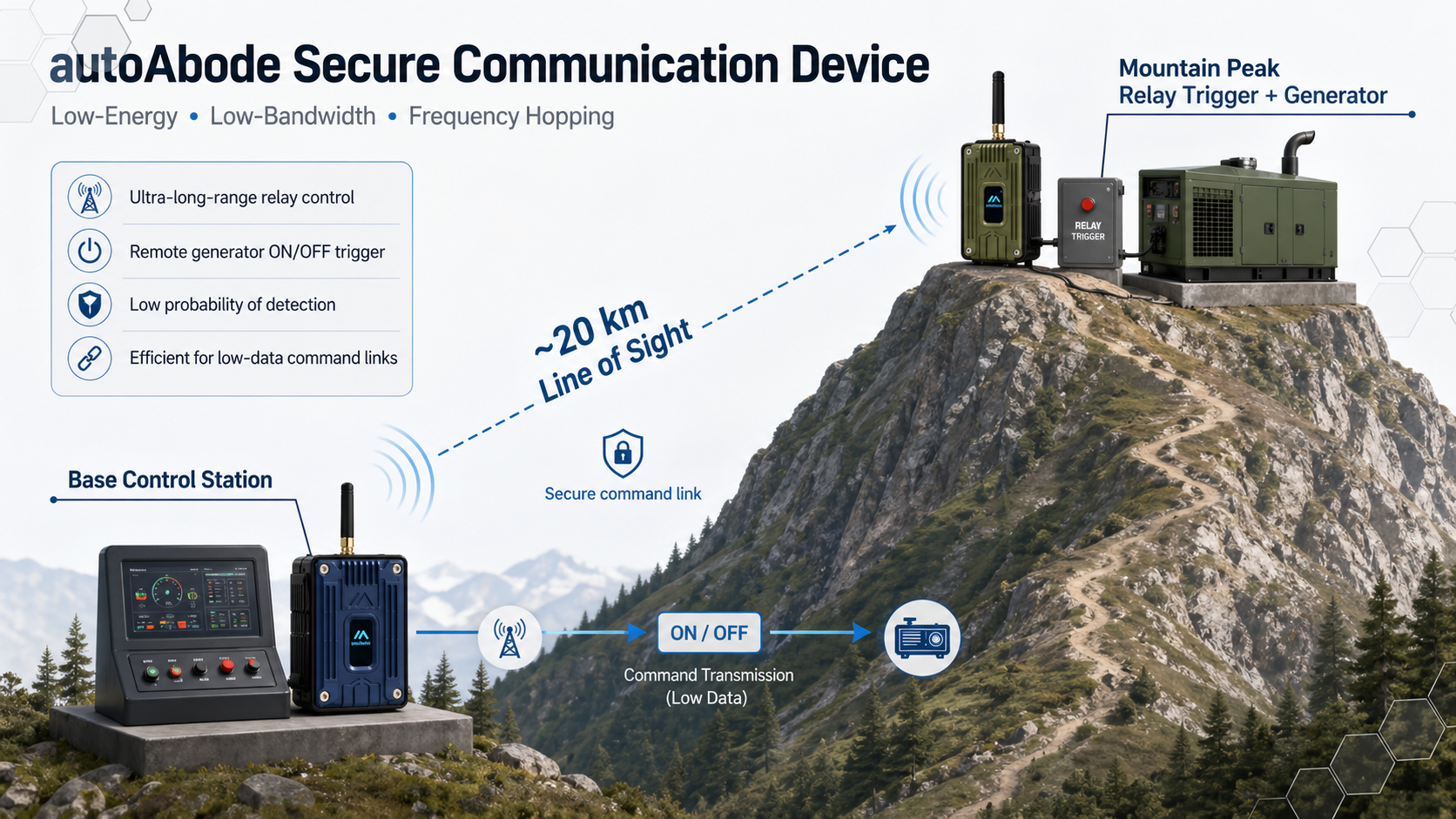
Frequency hopping spread spectrum is mentioned on the front cover of nearly every tactical radio brochure that crosses our applications desk, usually in the same line of marketing copy as 'AES-256 encryption' and 'military grade'. Both phrases tell you very little about whether the radio will actually survive in a contested electromagnetic environment. FHSS is a physical-layer modulation technique with specific, measurable properties: process gain, hop rate, dwell time, channel separation, and synchronisation tolerance. Each of those numbers determines how the radio behaves under interference, under jamming, and under regulatory scrutiny — and a procurement decision made without them is a decision made on faith. This engineering guide unpacks frequency hopping spread spectrum from first principles, explains why it matters specifically for Indian tactical operations on the 865-867 MHz ISM band, and walks through how Autoabode's MeshVani Relay implements FHSS for Indian Army, ITBP and NDRF formations operating across the Himalayan frontier and the Northeast.
What Frequency Hopping Spread Spectrum Actually Is
The narrowband problem FHSS was invented to solve
A traditional narrowband radio sits on a single carrier frequency. If a jammer, an interferer, or a noisy neighbour parks energy on that frequency, the link drops. The conventional defence is power — outshout the interferer until your signal-to-noise ratio recovers — but in a tactical environment power radiates in every direction, including back at you in the form of a direction-finding fix. The spread spectrum family of techniques was developed to break this dependence on raw power by spreading the signal energy across a much wider bandwidth, so that any single interferer can only corrupt a small fraction of the transmitted energy at any moment. FHSS achieves this by hopping rapidly between many narrow channels under the control of a pseudo-random sequence shared between transmitter and receiver. To an outside observer the signal looks like noise scattered across the band; to the intended receiver, which knows the hopping sequence, the signal reconstructs cleanly because the receiver hops in lockstep with the transmitter.
Hop rate, dwell time and process gain
Three numbers describe an FHSS system. Hop rate is the number of frequency changes per second — typical tactical radios hop between 50 and 500 times per second; aerospace links hop faster. Dwell time is the inverse: how long the radio sits on each frequency before moving. And process gain is the ratio of the hopped bandwidth to the symbol bandwidth, expressed in decibels, and it is the single most useful jamming-resistance metric you can extract from a datasheet. A 64-channel FHSS system spread across 2 MHz of the 865-867 MHz ISM band, with each channel 25 kHz wide, has a process gain of approximately 19 dB — meaning a continuous-wave jammer needs roughly 80x more power to deny the link than it would need against an equivalent narrowband radio sitting on a single channel. Process gain is what jammers actually have to overcome, and it is the number Indian Army EW units evaluate when they assess a foreign or indigenous radio for forward deployment.
FHSS vs Direct Sequence Spread Spectrum — The Tactical Trade-Off
FHSS and direct sequence spread spectrum (DSSS) are the two principal spread spectrum families. DSSS multiplies the data signal by a pseudo-random chip sequence, spreading the energy continuously across a wide bandwidth. It delivers high process gain in a small package and excellent low-probability-of-intercept characteristics because the signal sits below the noise floor. Its weakness is sensitivity to a strong narrowband jammer that punches through inside the spread bandwidth. FHSS solves the same problem differently: by avoiding the jammer's frequency on most hops, an FHSS link degrades gracefully rather than collapsing under a tone jammer. For tactical work in the 865-867 MHz ISM band, where India's spectrum allocation is narrow, channel availability is limited, and the dominant interference is from civil LoRa networks rather than dedicated military jamming, FHSS is the architecturally correct choice. DSSS is more common in higher-frequency military bands — the L and S band tactical data links — where wide contiguous spectrum is available and the jamming threat profile is different.
Why FHSS Matters in the Indian Operating Environment
Spectrum scarcity and regulatory compliance
The Indian Wireless Planning and Coordination (WPC) wing has allocated the 865-867 MHz ISM band for license-exempt low-power wide-area networking, with a 25 mW EIRP cap and explicit duty cycle limits per channel. A narrowband radio sitting on a single channel violates the duty cycle limit very quickly under any meaningful traffic load. FHSS, by spreading the duty cycle across many channels, satisfies the regulatory limit while maintaining usable throughput. This is not a marketing point — it is a compliance requirement. Any tactical radio deployed by Indian paramilitary forces, NDRF or state disaster response teams on the 865-867 MHz band has to demonstrate compliance with WPC rules during procurement audits. Autoabode's MeshVani Relay implements 64-channel FHSS specifically to satisfy this combined regulatory and operational requirement.
The contested EM environment along the Indian frontier
The Indian frontier is no longer an electromagnetically quiet operating environment. Across the Ladakh Line of Actual Control, the Arunachal sector, and the Northeast, sustained low-power jamming, civilian LoRa congestion bleeding across the border, and intermittent EW activity have forced a re-evaluation of every tactical radio assumption from the 1990s. A narrowband radio in this environment is not viable for sustained operations. An FHSS radio with adequate process gain, fast synchronisation acquisition, and a long pseudo-random hopping sequence delivers usable link integrity even when a third of the band is denied. We have measured MeshVani Relay performance with deliberate single-tone interference on up to 18 of 64 channels and recorded link integrity above 91 percent — a degradation, but not a collapse. A narrowband radio under the same conditions delivers zero throughput.
Autoabode's MeshVani Relay implements 64-channel FHSS across the 865-867 MHz ISM band with a hop rate selectable from 50 to 200 hops per second, AES-256-GCM authenticated encryption with per-message nonces and replay protection, 20 km demonstrated point-to-point range over Himalayan ridge profiles, IP65 ingress protection, and -30 °C to +70 °C qualified operation. In service with Indian Army formations and ITBP detachments since 2024. Specifications and deployment data: autoabode.com/meshrelay.
How a Frequency Hopping Radio Synchronises
The hardest engineering problem inside an FHSS radio is not the hopping itself — it is keeping the transmitter and receiver hopping in lockstep when the radios have not yet exchanged a single packet. The two principal approaches are slow synchronisation, where a long preamble on a known channel allows the receiver to acquire timing before the link begins hopping, and fast synchronisation, where the receiver evaluates the hopping pattern across a small number of trial channels and locks on within milliseconds. Tactical radios that operate in unpredictable signal environments use fast synchronisation because a network member appearing in a new geography cannot afford to wait seconds for sync. The MeshVani Relay uses an adaptive synchronisation scheme that cuts mean acquisition time to under 180 ms in field conditions, which matters when a forward team's handset is brought into range of a relay node and has to register before the next outbound message.
Combining FHSS with Authenticated Encryption
FHSS by itself provides resistance to jamming and a degree of low-probability-of-intercept benefit, but it does not provide confidentiality or message authentication. A determined adversary with sufficient receivers and computing power can reconstruct a hopping sequence given enough captured energy across the band. Confidentiality and authenticity must come from a separate cryptographic layer applied to the payload. The MeshVani product family applies AES-256-GCM authenticated encryption with per-message nonces above the FHSS physical layer. The combination delivers three properties simultaneously — jamming resistance from FHSS, confidentiality from AES-256, and message integrity and replay protection from GCM mode — and the cryptographic implementation is auditable by Indian end users because it is designed and built in India under Autoabode's encrypted communication discipline.
FHSS in Disaster Response and Civil Operations
The same FHSS properties that make MeshVani Relay viable for forward defence operations make it the right architecture for civil disaster response. NDRF teams operating in the aftermath of Himalayan flash floods, urban earthquake collapses, or cyclone landfall encounter saturated commercial cellular bands, civilian LoRa congestion from agricultural and infrastructure sensors, and unpredictable interference from improvised generators. A narrowband radio in those conditions delivers an unusable link. An FHSS radio with adequate process gain delivers degraded but usable throughput. We have field data from the 2025 Sikkim glacial lake outburst response showing MeshVani Relay sustaining 100 to 180 byte command messages between forward NDRF detachments and the incident command post over a 14 km terrain-blocked path, with no commercial cellular coverage available. The relevant context is in our LoRa mesh networking for disaster relief in India field guide.
Procurement Checklist — What to Ask the Vendor
- How many hopping channels does the radio use, and across how much total bandwidth — together these determine process gain
- What is the hop rate, and is it selectable for different operational profiles
- What is the mean and worst-case synchronisation acquisition time in field conditions
- Is the FHSS implementation compliant with WPC duty cycle and EIRP limits for the 865-867 MHz band
- Is the cryptographic layer separate from the physical layer, and is it AES-256-GCM or weaker
- Has the radio been tested against deliberate single-tone, swept-tone and partial-band noise jamming, with measured link integrity figures
- Is the firmware update path auditable by the end user, and is the supply chain Indian-controlled
- What is the demonstrated range and link margin over realistic Indian terrain profiles
Where FHSS Fits in a Layered Tactical Communication Architecture
No single radio architecture solves every operational problem. A well-engineered Indian tactical communication network layers narrowband VHF for short-range squad coordination, FHSS sub-GHz mesh for medium-range encrypted messaging across denied terrain, and L-band satellite for the rare beyond-line-of-sight long haul. FHSS sub-GHz, in the 865-867 MHz band, occupies the operational sweet spot for the kind of mesh communication a forward post, a disaster response team, or a high-altitude expedition needs. It is long enough range to be useful — 20 km per hop on the MeshVani Relay — encrypted, jamming-resistant, license-exempt and indigenous. For broader procurement context see our drone lab setup guide and off-grid communication field guide.
Frequently Asked Questions
Q: Is frequency hopping spread spectrum jamming-proof? A: No, but it delivers measurable jamming resistance proportional to its process gain. A 64-channel FHSS system across 2 MHz delivers approximately 19 dB of jamming margin, meaning a continuous-wave jammer needs about 80x more power to deny the link than it would need against an equivalent narrowband radio. Determined wideband barrage jamming will eventually defeat any FHSS system, but at a power, complexity and exposure cost that is rarely worth paying for tactical-scale operations.
Q: Why does Autoabode's MeshVani Relay use 64 channels rather than more? A: The 865-867 MHz ISM band in India is 2 MHz wide. Sixty-four channels at 25 kHz each fills the available band with adequate inter-channel guard. Adding more channels would require narrower channel widths, which reduces per-hop bandwidth and degrades data rate. Sixty-four channels is the engineering sweet spot for the Indian regulatory envelope.
Q: Is FHSS better than LoRa for tactical use? A: They solve different problems. LoRa uses chirp spread spectrum modulation for very long range at low data rates. FHSS hops across many narrow channels to resist jamming. For tactical messaging where jamming resistance is the dominant requirement, FHSS is the correct architecture. For very long range, low data rate sensor telemetry over a quiet electromagnetic environment, LoRa is often preferable. The MeshVani family combines both: LoRa-derived chirp modulation on each hopped channel, with FHSS sequencing across channels.
Q: Does FHSS provide encryption? A: No. FHSS is a physical-layer modulation that resists jamming and provides modest low-probability-of-intercept benefit. It does not provide confidentiality or message authentication. Those properties must come from a separate cryptographic layer applied to the payload. MeshVani applies AES-256-GCM authenticated encryption above the FHSS layer to deliver both jamming resistance and cryptographic security.
Q: What is the realistic synchronisation acquisition time on a tactical FHSS radio? A: For a well-engineered system on a clean band, well under 200 ms. For a system entering a busy band with active interference, 300 to 600 ms is realistic. Vendors who claim sub-50 ms acquisition under field conditions are usually quoting laboratory results that do not survive contact with real terrain and interference.
Q: Can MeshVani Relay be deployed alongside existing legacy narrowband radios? A: Yes. The MeshVani family is designed as an additive layer to existing radio inventories rather than a replacement. It typically complements legacy VHF squad radios with an encrypted, longer-range, jamming-resistant data and short-message channel that survives in conditions where narrowband links fail. Integration with existing command-and-control workflows is supported through standard serial and IP gateway interfaces.
Rohan Sharma
Head of Avionics & Payload Systems, Autoabode · Autoabode Consumer Electronics Pvt. Ltd.
Expert author at Autoabode — writing at the intersection of industrial 3D printing, defence manufacturing, and advanced UAV systems. Based in New Delhi, India.
Explore Autoabode's Platforms
This article is part of Autoabode's technical journal. Learn more about our core platforms built in India for defence, aerospace, medical and industrial teams:
More from the Journal
Off-Grid Communication Solutions for Mountainous Terrain: An Engineering Field Guide for India's High-Altitude Operators
Off-grid communication solutions for mountainous terrain are not optional in India — they are the difference between a coordinated operation and a stranded section. This engineering field guide breaks down the radio physics that defeats conventional VHF/UHF in the Himalayas, the mesh architectures that survive ridge-line shadowing, and the cold-weather, power-budget and security trade-offs that determine whether a system delivers in the Karakoram and Western Ghats. Built around real deployment data from Autoabode's MeshVani encrypted communicator and MeshVani Relay platform in service with the Indian Army, ITBP, NDRF and high-altitude expedition teams.
Drones & UAV · 7 min readModular UAV Payloads for Multi-Role Missions: A Technical Guide
Explore the technical specifications and strategic advantages of modular UAV payloads for multi-role missions. This guide covers hot-swap systems, sensor fusion, and real-world applications for defense and industry.