
Geopolymer Concrete 3D Printing: A Research Guide for Indian Universities, Material Scientists and Construction Engineers
Priya Mehta
Applications Engineer, Autoabode · Autoabode
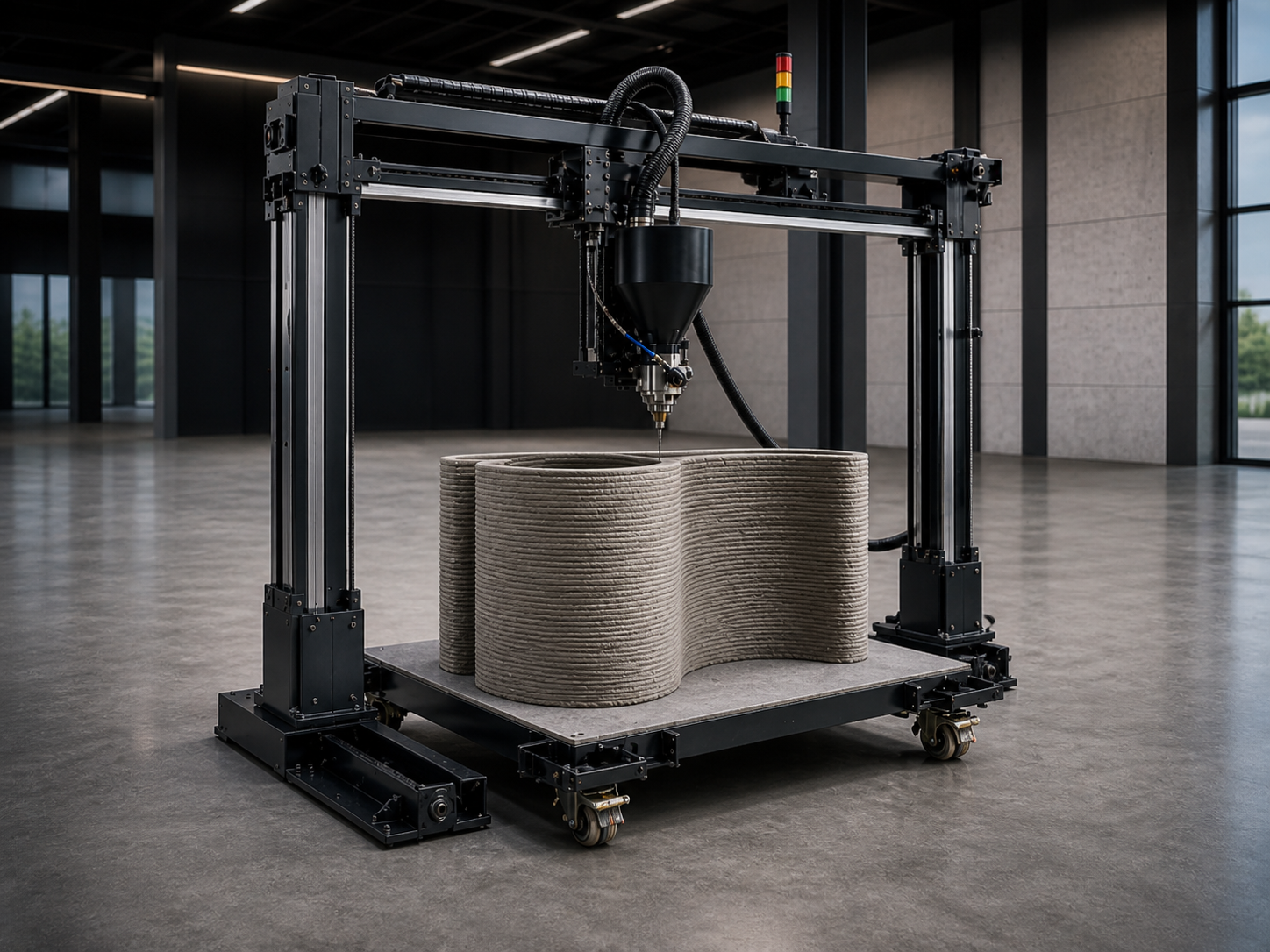
Geopolymer concrete has spent two decades in the materials science literature as the most credible large-volume replacement for ordinary Portland cement, and it is finally arriving on Indian research-lab print beds at meaningful scale. The reason this matters now, rather than in 2010 when the chemistry was already understood, is that 3D concrete printing has become the application that geopolymers are uniquely well suited to. Extrusion-based printing demands a binder system with tightly controlled rheology, predictable open time, and high early-age yield stress — and geopolymers deliver all three more naturally than Portland cement does, while embodying roughly 60 to 80 percent less CO2 per cubic metre. This guide is written for the Indian research community — IITs, NITs, applied research centres, and the growing number of private R&D groups working on construction additive manufacturing — that is now setting up geopolymer printing programmes and asking the same set of practical questions about chemistry, mix design, equipment, and research pathways. We answer them here, drawing on field data from Autoabode's Gantry 3D Concrete Printer deployed across Indian institutions since 2024.
What Geopolymer Concrete Actually Is — And Why It Matters for 3D Printing
Geopolymer concrete is not a single material but a family of alkali-activated binders in which an aluminosilicate source is dissolved by a strong alkaline solution and re-precipitates as a three-dimensional sodium aluminosilicate hydrate gel. There is no Portland cement and no calcium silicate hydrate in the system, which is why the embodied carbon profile is so different. The aluminosilicate sources used in Indian research are almost always industrial waste streams — pulverised fly ash from coal-fired thermal power plants and ground granulated blast furnace slag (GGBS) from steel production. The activator is typically a blend of sodium hydroxide and sodium silicate solutions in a controlled molar ratio. The resulting paste, when combined with fine and coarse aggregate, behaves rheologically very differently from a Portland cement concrete — and that difference is why it prints well.
Why extrusion printing favours alkali-activated systems
An extrusion-printable concrete needs four properties simultaneously. It must be pumpable through the delivery hose without segregation, extrudable through the print nozzle without tearing, buildable so that newly deposited layers do not collapse the printed structure underneath them, and open long enough that successive layers bond chemically rather than mechanically. Portland cement systems can be tuned to deliver these properties, but the tuning window is narrow and chemical admixture loadings are high. Alkali-activated geopolymer systems deliver an inherently higher initial yield stress, slower stiffening at the bottom of the open-time window, and faster strength gain at the end — all of which enlarge the workable printing envelope. For a research lab learning how to print, this is the difference between recoverable mistakes and an emergency cleanout of a clogged hose.
Geopolymer Chemistry — A Practical Refresher for Print Researchers
Source materials
Class F fly ash from Indian thermal power stations — Singrauli, Korba, Vindhyachal — is the workhorse aluminosilicate source for printable geopolymer mixes. Its low calcium content slows ambient-temperature reaction, which is bad for very fast strength gain but excellent for printability because it widens the open time. Ground granulated blast furnace slag is blended in at 20 to 50 percent by mass to accelerate setting and to drive early strength up to the 5 to 12 MPa one-hour figure that is needed for tall prints. The fly ash to GGBS ratio is the single most important compositional knob in printable geopolymer research, and most Indian groups standardise around 70/30 or 60/40 as their reference mix before exploring alternatives.
Activator solutions
The alkaline activator is conventionally a blend of sodium hydroxide pellets dissolved in deionised water and a commercial sodium silicate solution with a SiO2 to Na2O modulus typically between 1.6 and 2.4. The activator is mixed and then left to cool for 12 to 24 hours before use, because the hydroxide dissolution is exothermic and the activator viscosity changes substantially during cooling. Activator molarity — the concentration of sodium hydroxide expressed in mol per litre — is typically 8 to 14 M for printable mixes. Higher molarity drives faster reaction and higher ultimate strength, but it also shortens the open time, so the molarity selection is a direct trade against printability.
Mix Design Principles for Printable Geopolymer Concrete
The workability window
A printable geopolymer mix has to maintain a workable yield stress for as long as the print bed takes to build. For a small bench-scale wall element, that might be 30 minutes. For a full Autoabode Gantry print over a 2000 x 2000 x 2500 mm envelope, that is closer to 90 to 120 minutes of pumpable open time. The mix designer engineers this window by selecting fly ash to GGBS ratio, activator molarity, and the inclusion of retarders such as borax or sucrose. We strongly recommend that research groups instrument their early mixes with a stress growth rheometer or, at minimum, a slump retention test at five-minute intervals — guessing at open time from setting-time tables developed for Portland cement is the most common cause of failed first prints.
Buildability and yield stress
Buildability is governed by the static yield stress of the freshly deposited layer immediately after extrusion. Empirical work across Indian and Australian research groups converges on a target initial static yield stress of 1.0 to 2.5 kPa for stable layer stacking, rising to 4 to 8 kPa within ten minutes as the layer stiffens. A mix that fails buildability tests is usually overdosed on superplasticiser, under-dosed on GGBS, or carrying too high a water content. The diagnostic to run before adjusting the mix is a flow table test at 0, 5, 10 and 15 minutes — the rate of flow loss tells you whether the open-time window is converging toward a printable profile.
Print Parameters — Translating Mix Design Into Build Quality
Once a mix has been characterised, the print parameters that matter most are nozzle diameter, layer height, print speed, layer time, and pumping pressure. Indian research groups working with the Autoabode Gantry system typically standardise on a 30 mm circular nozzle, a 15 mm layer height, a print speed of 80 to 120 mm per second, and a layer time of 60 to 180 seconds. Pumping pressure tracks viscosity and is usually monitored as a diagnostic for mix consistency rather than as a control parameter. The first quality milestone is achieving consistent layer width across a 1 m straight wall — variation of more than 5 percent indicates that either the pumping system has settled inconsistently or the mix has gone outside its workability window.
Equipment Considerations — Why Gantry Architectures Matter for Research
Construction 3D printers come in three principal architectures. Articulated robotic arms are flexible but small in build envelope and expensive in payload-rated configurations. Crane-style boom printers handle large volumes but are mechanically compliant, which compromises layer geometry on tall, slender prints. Gantry architectures — a Cartesian frame with the print head moving in X, Y and Z over a fixed bed — deliver the rigidity, repeatability and instrumentation access that research demands. Layer geometry is reproducible to within 1 mm across a 2 metre print, which means experimental variables are isolated from machine variability. For a research programme studying mix design, this is decisive: any layer geometry artefact has to be attributable to the material, not to the machine.
Autoabode's Gantry 3D Concrete Printer delivers a 2000 x 2000 x 2500 mm build envelope, a 30 mm interchangeable nozzle, a peristaltic pump rated to 4 cubic metres per hour, layer accuracy of plus or minus 1 mm, and a fully open control stack — G-code, Python and ROS — that allows research groups to integrate their own slicers, rheology sensors and live mix-correction logic. Deployed across Indian engineering institutions and applied research centres since 2024 for fly ash and GGBS geopolymer studies. Specifications and academic deployment data: autoabode.com/concrete-3d-printer.
Research Pathways for Indian Universities and Research Centres
A geopolymer 3D printing research programme in an Indian engineering institution typically progresses through four phases. The first is binder characterisation — fly ash and GGBS particle size distribution, oxide composition, and activator-binder dissolution kinetics. The second is mix design optimisation — varying fly ash to GGBS ratio, activator molarity, water-to-binder ratio and superplasticiser dosage to identify a printable envelope. The third is print trials at increasing scale, starting with bench-scale wall elements and progressing to full-bed structural prints. The fourth is mechanical characterisation of the printed elements — anisotropic compressive strength, interlayer bond strength, flexural strength, and durability under sulphate and chloride exposure. Each phase produces publishable research, and the cumulative data is what convinces the Bureau of Indian Standards committees that printed geopolymer construction is ready for code-track inclusion.
Sustainability Metrics — Why This Research Matters Now
The embodied carbon of one cubic metre of M30-equivalent Portland cement concrete is conventionally taken as around 380 to 440 kg CO2-equivalent. The same strength class delivered as a fly ash and GGBS geopolymer concrete sits between 90 and 180 kg CO2-equivalent depending on activator dosage and supply chain. For a country like India, with construction activity projected to consume 600 million tonnes of cement annually by 2030, even a 5 percent substitution of Portland cement with printable geopolymer concrete delivers carbon savings measured in tens of millions of tonnes per year. That is the strategic context inside which Indian research groups, the Bureau of Indian Standards and the Ministry of Housing and Urban Affairs are now investing in printable geopolymer R&D — and it is why a research programme in this area is materially more impactful than another Portland cement printability study.
Common Failure Modes in Early-Stage Geopolymer Print Research
- Activator solution prepared and used the same day — heat of dissolution distorts viscosity and gives misleading rheology data; cool the activator for at least 12 hours before mixing
- Fly ash sourced from a different power station than the previous batch — inter-station variation in glassy phase content is large enough to invalidate prior mix-design data
- GGBS dosage above 50 percent in pursuit of fast setting — the open time collapses below the duration of a meaningful print; cap GGBS at 40 percent for first prints
- Print speed mismatched to extrusion rate — layer width drifts visibly across the print; calibrate by extruding 1 m straight bead at zero translation before each session
- Insufficient nozzle stand-off from the previous layer — top surface of the previous layer is dragged, causing tearing; standard stand-off is layer height minus 1 to 2 mm
- No instrumentation on pumping pressure — viscosity excursions go undetected until the print fails; add a simple inline pressure transducer as the first sensor in any research rig
- Curing protocol borrowed from Portland cement literature — geopolymer curing optimum is 24 to 48 hours at 40 to 60 C in sealed humidity, not 28 days under water
- Treating embodied carbonant across activator suppliers — sodium silicate from different processes carries widely different upstream emissions; document the supply chain as part of every mix
A Practical Workflow for Setting Up a Geopolymer 3D Printing Research Programme
A new research group can be productive within 12 weeks of equipment delivery if the workflow is sequenced correctly. Weeks one and two are devoted to binder and activator characterisation in the existing materials lab — particle size, oxide chemistry, activator molarity verification. Weeks three to five run mix-design optimisation at the bench scale using a planetary mixer and standard rheology instrumentation. Weeks six and seven are dedicated to first prints on the gantry system using a known reference mix to commission the machine and the workflow. Weeks eight through twelve are research prints in which one variable at a time is changed against the reference mix, and mechanical characterisation begins. We have walked five Indian institutions through this exact sequence on the Autoabode Gantry 3D Concrete Printer and have published joint case studies with three of them. For broader context on the construction printing landscape in India, our 3D concrete printing in India guide covers the regulatory and procurement landscape that surrounds research deployments.
Frequently Asked Questions
Q: Can a research group start with Portland cement printing and migrate to geopolymer later? A: Yes — that is the most common and the most sensible sequencing. Portland cement printing is forgiving and lets the team commission the gantry and the workflow against a familiar binder before introducing the chemistry of geopolymers. Most Indian research groups we work with print Portland cement for the first six to eight weeks and migrate to geopolymer mixes once the equipment workflow is reliable. The Autoabode Gantry system supports both binder families on the same machine without hardware modification.
Q: What is the realistic embodied carbon reduction for a printable geopolymer compared to Portland cement of the same strength? A: For an M30-equivalent printable mix, fly ash and GGBS geopolymer concrete typically delivers 60 to 80 percent embodied carbon reduction relative to Portland cement of the same strength. The variation is dominated by activator dosage and by the upstream emissions of the sodium silicate supplier. Research-grade reporting should always declare the activator supply chain alongside the mix-design carbon figure.
Q: How long does a geopolymer print typically take to reach handling strength? A: For a fly ash and GGBS blend at ambient Indian temperatures, handling strength of around 5 MPa is reached at 24 to 36 hours and design strength at 7 to 14 days depending on curing conditions. With heat curing at 40 to 60 C for 24 to 48 hours, design strength is reached within 72 hours. Handling strength gain is faster than equivalent Portland cement systems with similar replacement ratios, which is one of the practical reasons geopolymer printing is operationally attractive for construction schedules.
Q: What are the regulatory hurdles to printing geopolymer building elements in India? A: The Bureau of Indian Standards has published draft codes for 3D concrete printing and is actively reviewing alkali-activated binder specifications. As of mid-2026 the framework permits research and demonstration prints, with structural certification requiring third-party characterisation per existing IS specifications applied to printed test specimens. The Ministry of Housing and Urban Affairs is funding pilot projects through CSIR-CBRI and CSIR-SERC, and several engineering institutions are publishing research that feeds into the standards process.
Q: Does Autoabode's Gantry 3D Concrete Printer come with a reference geopolymer mix recipe? A: Yes. Autoabode supplies a parameterised reference mix design — fly ash to GGBS ratio, activator molarity, water-to-binder ratio, superplasticiser dosage and target rheology — that has been validated against the gantry pumping system and a 30 mm nozzle. Research groups typically use the reference mix as a commissioning recipe and then evolve their own mix designs from it. The reference mix and the associated print parameter file are provided as part of the standard deployment package, alongside training and applications-engineering support during commissioning.
Priya Mehta
Applications Engineer, Autoabode · Autoabode Consumer Electronics Pvt. Ltd.
Expert author at Autoabode — writing at the intersection of industrial 3D printing, defence manufacturing, and advanced UAV systems. Based in New Delhi, India.
Explore Autoabode's Platforms
This article is part of Autoabode's technical journal. Learn more about our core platforms built in India for defence, aerospace, medical and industrial teams:
More from the Journal
Off-Grid Communication Solutions for Mountainous Terrain: An Engineering Field Guide for India's High-Altitude Operators
Off-grid communication solutions for mountainous terrain are not optional in India — they are the difference between a coordinated operation and a stranded section. This engineering field guide breaks down the radio physics that defeats conventional VHF/UHF in the Himalayas, the mesh architectures that survive ridge-line shadowing, and the cold-weather, power-budget and security trade-offs that determine whether a system delivers in the Karakoram and Western Ghats. Built around real deployment data from Autoabode's MeshVani encrypted communicator and MeshVani Relay platform in service with the Indian Army, ITBP, NDRF and high-altitude expedition teams.
Drones & UAV · 7 min readModular UAV Payloads for Multi-Role Missions: A Technical Guide
Explore the technical specifications and strategic advantages of modular UAV payloads for multi-role missions. This guide covers hot-swap systems, sensor fusion, and real-world applications for defense and industry.