
Mesh Radio Networks for Indian Army Forward Posts: A Field Engineer's Guide to LoRa Mesh, FHSS Relays and Encrypted Tactical Comms in the Himalayas
Shubham Garg
Founder & Managing Director, Autoabode · Autoabode
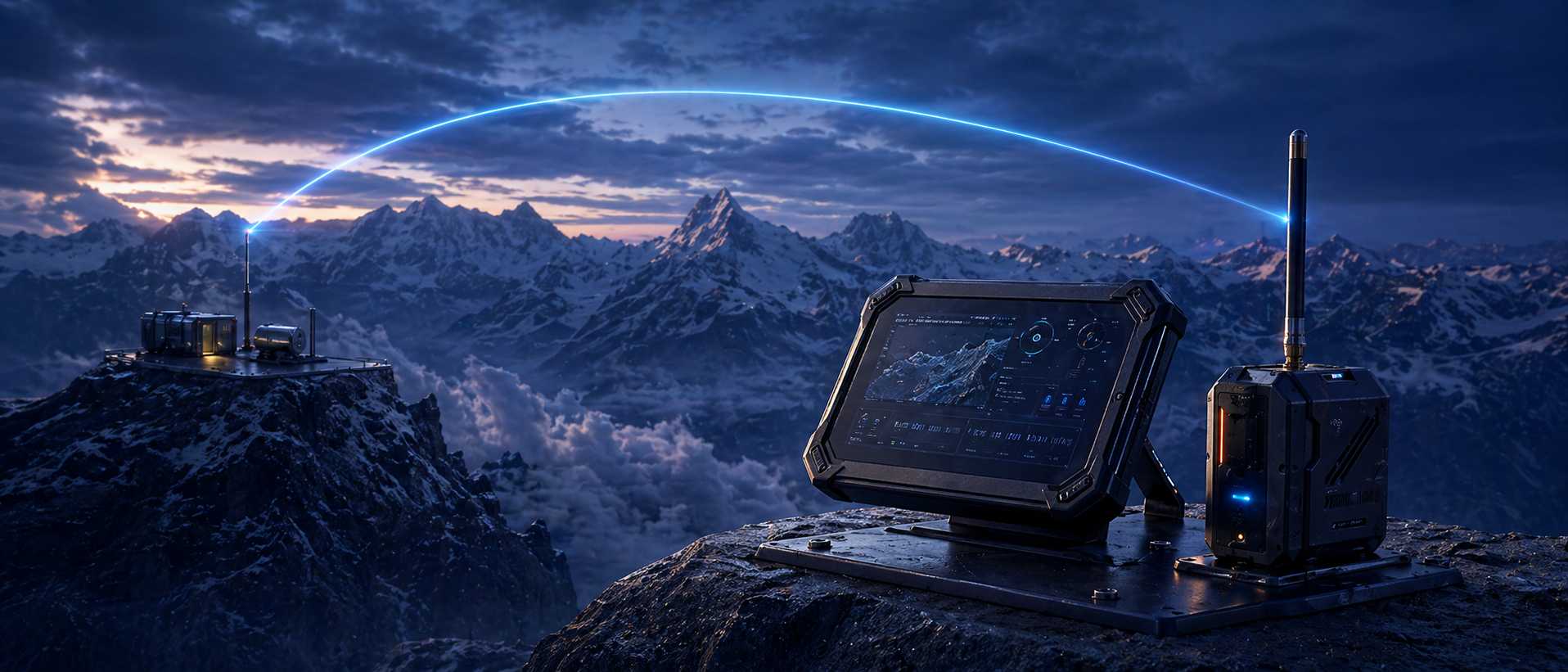
A forward post on the Line of Actual Control is, in radio terms, one of the most hostile environments on the planet. Ridge-line shadowing kills VHF and UHF point-to-point links. Cellular infrastructure does not exist. Satellite handsets are expensive, slow to acquire signal in narrow valleys, and concentrate traffic at a few choke-points that an adversary's signals-intelligence cell will map within weeks. The operational requirement at a forward post is the opposite of what these systems deliver: short, encrypted, low-probability-of-intercept bursts that carry section-level situational data back to company headquarters with no dependence on overhead infrastructure. Over the past three years, mesh radio networks built on LoRa modulation and frequency-hopping spread spectrum relays have emerged as the system of choice for exactly this requirement, and the Indian Army has been quietly procuring them at scale. This guide explains why.
Why Point-to-Point VHF and UHF Fail at Forward Posts
VHF and UHF radios depend on either line of sight or single-hop refraction off ionised layers above the operating area. In the Himalayas, neither condition holds reliably. A section observation post at 4,200 metres on a north-facing slope is shadowed by the very ridge it is observing. The company command post, three kilometres horizontally and 600 metres lower, is on the opposite side of a spur. The direct path is blocked by tens of metres of granite. The diffraction-loss budget for a 144 MHz or 400 MHz link across such a path is typically 40 to 60 dB worse than free space, which a 5 W handheld set cannot close. Operators compensate by climbing to a ridge, taking on weather and observation risk, or by routing through a battalion-level HF skywave net that is slow, unencrypted in many legacy deployments, and trivially intercepted by adversary direction-finding.
Mesh Architecture — How LoRa Restores Connectivity
A LoRa mesh network solves the ridge-line problem with two ideas applied in combination. The first is the LoRa physical layer itself: chirp spread spectrum modulation, designed for sensitivity below the noise floor, that achieves a usable link budget around 155 dB at the slowest spreading factor. That is 15 to 25 dB more than conventional narrowband FM at the same transmit power, which means a 1 W LoRa transmission travels further than a 5 W FM transmission on the same antenna over the same path. The second is mesh routing: every node is both an endpoint and a router. A packet that cannot reach the destination directly is forwarded by an intermediate node — typically a MeshVani Relay installed on a ridge or saddle that has line of sight to both ends of the path. The mesh layer handles route discovery, store-and-forward retries, and graceful degradation when a node drops out, all without intervention from the operator at the section level.
Typical Forward-Post Mesh Topology
A representative deployment in the Ladakh sector looks like this. Each section observation post carries one MeshVani handheld communicator on the section commander, plus one fallback unit at the post. The platoon command post, around 2 to 4 kilometres back, carries two MeshVani units and serves as the platoon-level aggregation point. Between the platoon command post and the company headquarters, one or two MeshVani Relay nodes are installed on terrain features chosen for ridge-line coverage — solar-powered, weather-sealed, and designed to run unattended for the duration of a deployment cycle. The company headquarters carries a base-station-configured MeshVani with a directional Yagi antenna pointed at the dominant relay. The result is a five-hop mesh that covers a battalion's frontage with no single point of failure: any one relay can be taken offline by terrain, weather or jamming, and the mesh re-routes within seconds.
Encryption — Why AES-256-GCM Is the Operational Floor
Encryption at the forward edge is not a feature; it is the entire point. An unencrypted tactical radio in 2026 is a beacon — it tells an adversary's signals-intelligence cell where the section is, how many sections are in the area, when they move, and what their reporting pattern looks like. The MeshVani platform implements AES-256-GCM, which combines a 256-bit confidentiality cipher with a 128-bit authenticated-encryption tag on every packet. Authentication is operationally as important as confidentiality. Without authentication, an adversary that records a single legitimate packet can replay it later, or forge spoofed packets that the receiver cannot distinguish from real traffic. AES-256-GCM tags catch both attacks: a single bit-flip in a recorded packet, or any forged packet without the correct key, fails the tag check and is silently dropped at the receiver.
Frequency Hopping and Low Probability of Intercept
AES-256 protects the contents of a packet, but it does not protect the fact that a packet was transmitted at all. An adversary with a wideband scanner can still see emissions, direction-find them and triangulate the transmitter. The MeshVani Relay platform layers frequency-hopping spread spectrum on top of LoRa to attack this second problem. The relay hops across a programmable channel set on a key-derived schedule, dwelling on each channel for milliseconds at a time. A wideband scanner sees brief, scattered energy bursts that are difficult to associate with a single emitter, and direction-finding becomes correspondingly harder. For our primer on frequency hopping spread spectrum, see the dedicated explainer. For forward-post deployments, the operational benefit is that the relay can be installed on a permanent terrain feature without becoming a permanent radio fingerprint.
Specifications That Matter at the Forward Edge
- Receive sensitivity better than -137 dBm at the slowest spreading factor — this sets the link budget across shadowed terrain
- Transmit power software-selectable from 14 dBm to 30 dBm — operator must be able to reduce emissions when concealment is more important than range
- AES-256-GCM authenticated encryption on every packet — confidentiality plus replay and forgery protection
- FHSS dwell time below 50 milliseconds with a channel set of 50 or more channels — defeats narrowband interception and complicates direction-finding
- Onboard key zeroisation — physical button or remote command that wipes keys in under one second if a unit is compromised
- Operating temperature range from -30 C to +60 C — the device must function in a Ladakh winter and a Rajasthan summer without environmental control
- IP67 sealing and shock rating equivalent to MIL-STD-810 — forward-post equipment is dropped, soaked and frozen
- Battery life of 36 to 72 hours on a single charge at typical section duty cycle — units must outlast a patrol cycle without resupply
Power and Mounting at Unattended Relay Sites
A ridge-line relay is unattended for weeks to months. Power and mounting are therefore as important as the radio itself. A typical MeshVani Relay site carries a 100 to 200 watt solar panel, a 50 to 100 amp-hour LiFePO4 battery sized for ten days of autonomy through a Himalayan overcast spell, a charge controller rated for high-altitude UV exposure, and a mast of 3 to 6 metres with a guy-wire kit. The radio itself sits in a sealed enclosure at the top of the mast, with the antenna directly above it to minimise feed-line loss. Operators commission the relay by orienting the antenna against a known reference node, locking the orientation with the guy-wire kit, and verifying mesh membership from a handheld unit before leaving the site. Site selection prioritises ridges and saddles with two-way line of sight to the expected mesh population — a single well-placed relay can carry traffic for a brigade frontage.
Autoabode's MeshVani Relay delivers a 20 km nominal one-hop range over ridge-line terrain, AES-256-GCM authenticated encryption, programmable FHSS with sub-50 ms dwell, IP67 sealing, an operating range of -30 C to +60 C, and a power budget compatible with a 100 W solar plus 50 Ah LiFePO4 stand-alone site. Deployed with the Indian Army, ITBP and Assam Rifles since 2024 across Ladakh, Sikkim and Arunachal Pradesh. Specifications and deployment data: autoabode.com/meshrelay.
Operational Doctrine — How Mesh Changes Forward-Post Practice
A reliable, encrypted, low-emission mesh at the forward edge changes the way a section operates in subtle but important ways. The section commander can report contact, position and ammunition status as short text bursts rather than voice calls that occupy the net and expose the position. The platoon command post receives aggregated section status as structured data, which is easier to consume during a contact than fragmentary voice traffic. The company headquarters runs an aggregation display that shows section positions and status updates without operator intervention. Voice remains available for emergencies and command direction, but the routine reporting workload that historically dominated forward-post nets is shifted to the data layer, which is faster, more reliable, and harder to intercept.
Comparison With Legacy and Alternative Systems
Against legacy VHF and UHF point-to-point sets, the LoRa mesh wins on link budget, encryption strength and electromagnetic discipline. Against satellite handsets, it wins on cost per node, indoor-to-indoor latency, and freedom from a single overhead point of failure. Against HF skywave, it wins on encryption, on latency under typical operating conditions, and on the absence of an HF antenna footprint that is itself a tactical signature. The trade-off is throughput: a LoRa mesh is engineered for short, structured messages, not for streaming video or large file transfers. For those use cases, a forward post can fall back to a satellite link or to a tactical-LTE bubble; for the routine business of section reporting, the mesh delivers what nothing else does. For a broader comparison of mesh radio against other off-grid options, see our off-grid communication solutions for mountainous terrain field guide.
Procurement Considerations for Indian Defence Buyers
Procurement of tactical mesh equipment in India runs through the Defence Acquisition Procedure and, increasingly, through the Innovations for Defence Excellence and Make-II pathways for Indian-developed systems. Buyers evaluating mesh radio offerings should focus on five categories: indigenous content and IP ownership, encryption certification by trusted Indian agencies, environmental qualification against operating-area extremes, mesh-routing performance under emulated jamming and node loss, and field-trial data from the actual area of deployment. The MeshVani platform has been developed end-to-end in India by Autoabode, with full IP retained domestically, with encryption review handled through trusted-vendor processes, and with field-trial data accumulated through deployments with the Indian Army, ITBP and Assam Rifles. The result is a system that satisfies the Atmanirbhar Bharat procurement framework without compromising on the operational specifications that the forward edge demands.
Common Mistakes in Mesh Network Design for Forward Posts
- Treating mesh as a drop-in replacement for VHF voice — the data-first workflow needs operator training and a structured reporting template, not a microphone
- Placing relays on operationally convenient sites rather than radio-optimal sites — five extra minutes of climb saves hours of mesh debugging later
- Skipping the ten-day battery autonomy spec — a relay that goes dark for a week of overcast weather will not be trusted operationally even after it returns
- Using the same encryption key for the entire battalion — section, platoon and company nets should be separately keyed to limit the blast radius of a single compromise
- Treating FHSS as optional — emissions discipline matters; a single steady-carrier relay can be direction-found within a week of operation
- Provisioning units without zeroisation drills — operators must rehearse remote and local key wipe, including the procedure to be followed after a unit goes missing on patrol
- Sizing the mesh for clear-air range rather than for the worst-case shadowed path — every link in the mesh has to close in the conditions the section actually fights in
- Ignoring the antenna — the difference between a poorly mounted whip and a properly oriented Yagi at the company command post is 10 to 15 dB of link margin, which is the difference between connectivity and silence
A Practical Field-Trial Sequence Before Operational Deployment
Before any mesh system is deployed operationally, a unit should run a structured field-trial sequence. Week one is configuration and key management — every unit programmed, keys distributed under controlled conditions, zeroisation drilled at every level. Week two is range and shadowing trials — every section-to-platoon and platoon-to-company path is walked, link margins measured, and relay placements iterated until the worst-case path closes with at least 10 dB of margin. Week three is endurance — units run continuously through a full operating cycle, batteries cycled, solar power validated under overcast conditions. Week four is exercise — the mesh is used as the primary net for a multi-day exercise, with deliberate jamming and node-loss injects to validate mesh-routing performance under degradation. Only after week four does the mesh take over operational duty. Autoabode's applications-engineering team has walked seven Indian Army formations through exactly this sequence and publishes redacted field-trial templates as part of the MeshVani deployment package.
Frequently Asked Questions
Q: What range can I expect from a MeshVani handheld to another MeshVani handheld at a forward post? A: Over flat or rolling terrain with good antenna placement, handheld-to-handheld range at the slowest spreading factor is typically 8 to 12 kilometres. Across ridge-line shadowed terrain, direct handheld-to-handheld range collapses to a few hundred metres to a few kilometres depending on path geometry. The operational range is restored by the mesh: a single MeshVani Relay on the dominant ridge extends usable connectivity to 20 kilometres or more, and a two-hop mesh covers a battalion frontage. Range planning at the forward post is always a mesh-design exercise, not a single-link exercise.
Q: Is the MeshVani encryption certified for use on Indian defence networks? A: The MeshVani platform implements AES-256-GCM, which is the international standard for authenticated encryption and is acceptable across allied defence procurement frameworks. Indian-specific certification pathways are handled on a deployment-by-deployment basis with the procuring agency, and Autoabode supplies the documentation and source-code review access required for those pathways. The platform is engineered to support Indian-controlled key material end-to-end, with no foreign-controlled cryptographic dependencies.
Q: How does the mesh perform under deliberate jamming? A: LoRa modulation has a process gain of around 15 to 25 dB against narrowband interference at the slowest spreading factor, which means a narrowband jammer must out-power the desired signal by a wide margin at the receiver to deny the link. Frequency hopping on the relay layer further degrades a jammer's ability to concentrate energy on the channel currently in use. Mesh routing then re-routes around any individual hop that fails. The net result is that a section that loses the direct hop to its platoon under jamming usually finds the mesh has automatically routed the traffic via a relay hop within seconds. Performance under realistic jamming is documented per-deployment as part of the field-trial sequence.
Q: What happens if a MeshVani unit is captured on patrol? A: A captured unit can be remotely zeroised from the command net within seconds of the loss being reported. If remote zeroisation cannot be performed because the unit is already outside mesh range, the section, platoon and company keys are rotated to keys held in the spare-key envelope at the company command post, and the captured unit becomes an inert handset with no current key material. The mesh continues to operate normally on the new key set. Operators rehearse this drill during the configuration and key-management week of the deployment sequence.
Q: Can a MeshVani mesh integrate with existing VHF or HF nets at the company command post? A: Yes. The MeshVani base-station configuration at the company command post can be operated alongside legacy VHF and HF sets, with the company signaller bridging traffic between nets manually where required. The platform also exposes a structured-message gateway that can forward mesh traffic to a tactical computing environment for aggregation with other situational-awareness data. Most forward-post deployments run the mesh as the primary net for section reporting while retaining legacy VHF for voice command and HF for fallback connectivity, which is the configuration the Indian Army has standardised on across the units that operate the system today.
Shubham Garg
Founder & Managing Director, Autoabode · Autoabode Consumer Electronics Pvt. Ltd.
Expert author at Autoabode — writing at the intersection of industrial 3D printing, defence manufacturing, and advanced UAV systems. Based in New Delhi, India.
Explore Autoabode's Platforms
This article is part of Autoabode's technical journal. Learn more about our core platforms built in India for defence, aerospace, medical and industrial teams:
More from the Journal
Off-Grid Communication Solutions for Mountainous Terrain: An Engineering Field Guide for India's High-Altitude Operators
Off-grid communication solutions for mountainous terrain are not optional in India — they are the difference between a coordinated operation and a stranded section. This engineering field guide breaks down the radio physics that defeats conventional VHF/UHF in the Himalayas, the mesh architectures that survive ridge-line shadowing, and the cold-weather, power-budget and security trade-offs that determine whether a system delivers in the Karakoram and Western Ghats. Built around real deployment data from Autoabode's MeshVani encrypted communicator and MeshVani Relay platform in service with the Indian Army, ITBP, NDRF and high-altitude expedition teams.
Drones & UAV · 7 min readModular UAV Payloads for Multi-Role Missions: A Technical Guide
Explore the technical specifications and strategic advantages of modular UAV payloads for multi-role missions. This guide covers hot-swap systems, sensor fusion, and real-world applications for defense and industry.