
3D Printed Spare Parts for Military Vehicles: An On-Demand Manufacturing Field Guide for Indian Defence Logistics
Shubham Garg
Founder & CEO, Autoabode Consumer Electronics Pvt. Ltd. · Autoabode
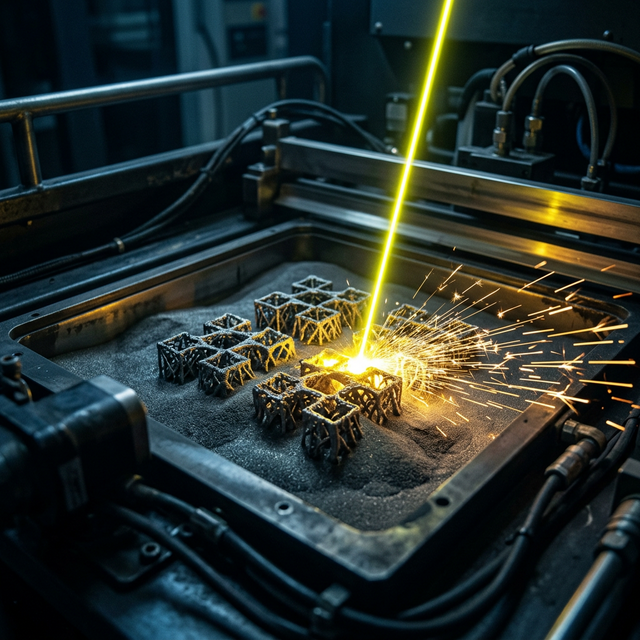
3D printed spare parts for military vehicles have moved, in the space of a few years, from a laboratory curiosity to a serious instrument of defence logistics, and the reason is brutally practical. A modern armoured fighting vehicle, gun-towing truck or engineering plant is a thousand-part machine, and the failure of a single non-load-bearing component — a coolant manifold bracket, a worn bushing, a cracked instrument housing, an obsolete gasket — can deadline that vehicle for weeks while a replacement is sourced from an original equipment manufacturer who may have stopped making the part a decade ago. For India's defence forces, operating mixed fleets of legacy Soviet-origin platforms alongside newer indigenous and Western systems across terrain from the Thar to the Siachen, the spares problem is not primarily about big-ticket assemblies; it is about the long tail of small, unglamorous parts that no inventory model can fully anticipate. This is exactly the gap that additive manufacturing fills. This field guide sets out which vehicle components are realistic candidates for printing, what the technology can and cannot do, how a printed part is qualified for service, and how an on-demand capability reshapes the supply chain. Throughout, we draw on deployment experience with Autoabode's SinterX Pro industrial SLS system and Duper Series large-format FDM platforms.
Why the Spare-Parts Tail Is a Readiness Problem, Not Just a Cost Problem
Conventional military logistics manages spares through forecasting: estimate the failure rate of each part, hold enough stock at depots to cover expected demand, and reorder as stock depletes. This works well for high-volume consumables and predictable wear items. It works poorly for the enormous tail of low-demand parts — components that fail rarely and unpredictably, but when they fail, ground the whole vehicle. Holding deep inventory of every conceivable part across every depot is financially impossible and logistically absurd; you would be warehousing tens of thousands of items that may never be issued. The result is that fleets accumulate ‘awaiting spares’ vehicles, cannibalisation becomes routine (stripping parts from one grounded vehicle to keep another running), and operational availability quietly erodes. The deeper issue is that this is a readiness problem disguised as a cost problem: every deadlined vehicle is combat power that exists on paper but not in the field.
Additive manufacturing attacks this from a different direction. Instead of trying to predict and pre-position physical inventory, you hold a digital inventory — a validated, version-controlled library of part files — and manufacture the physical part on demand, at the point of need or at a regional depot, only when it is actually required. The economics invert: the cost of carrying a digital part is negligible, and the marginal cost of producing one is the machine time and a few hundred grams of polymer. For the long tail specifically, this is transformational.
Which Vehicle Parts Are Realistic Candidates
The single most important discipline in defence additive manufacturing is honest part selection. The technology is not a universal replacement for forged steel and machined alloy, and pretending otherwise is how programmes lose credibility. The right mental model is to sort every candidate part by what its job actually is.
Strong candidates: functional polymer parts
The sweet spot is functional non-structural and semi-structural components that were originally injection-moulded, cast in polymer, or machined from plastic stock. These are everywhere on a vehicle: electrical connector housings and junction boxes, cable routing clips and grommets, dashboard and instrument-panel fascias, ducting and air-vent components, fluid-reservoir caps and brackets, sensor mounts, door and hatch handles, protective covers, and the countless small jigs and fixtures used in maintenance itself. Printed in engineering nylon, these parts match or exceed the durability of the originals while being available in hours rather than months.
Conditional candidates: load-bearing brackets and bushings
Many metal brackets, spacers, bushings and wear pads can be successfully replaced with high-performance polymers, but only after engineering analysis. A bracket that holds a wiring loom is trivial; a bracket in a vibration-loaded driveline path is not. Glass-filled and carbon-filled nylons, and high-temperature polymers like PA11 and PPA, extend the envelope considerably, but each such part needs its loads, temperatures and chemical exposure assessed before it is cleared. This is engineering work, not printing work.
Poor candidates: primary structure and high-stress metal
Primary load-bearing structure, armour, powertrain internals, pressure-bearing hydraulics and anything operating at high temperature in a fatigue-critical role are not candidates for polymer additive manufacturing. Metal additive (laser powder-bed fusion) can address some of these, but it is a depot-and-OEM-level capability with its own qualification burden, not a forward-deployable one. Disciplined programmes are explicit about this boundary.
Autoabode's SinterX Pro is India's first indigenous industrial SLS 3D printer, building fully dense, isotropic nylon parts in PA12 and PA11 with no support structures and complete geometric freedom — the exact profile required for functional vehicle spares. Paired with the large-format Duper Series FDM platforms for bigger, lower-stress components and the open SLS material ecosystem for application-matched powders, it gives defence workshops a domestically built, serviceable additive capability free of import lead times and export-control friction.
Why SLS Nylon and Large-Format FDM Cover Most of the Demand
For the candidate parts above, two technologies do the overwhelming majority of the real work, and it is worth understanding why.
SLS nylon for functional, durable parts
Selective laser sintering fuses nylon powder layer by layer inside a heated chamber, with the surrounding unsintered powder supporting every feature. The result is a fully dense, isotropic part with mechanical properties close to injection-moulded nylon and no weak inter-layer bond direction — which matters enormously for a part that will be vibrated, flexed and impacted in a vehicle. PA12 is the workhorse: tough, chemically resistant to fuels and oils, and dimensionally stable. PA11, a bio-derived polyamide, offers greater impact resistance and flexibility for parts that must survive shock and cold. Because SLS needs no support structures, it prints the complex, enclosed geometries typical of housings and ducting in a single job. Our PA12 versus PA11 material guide covers the selection logic in depth.
Large-format FDM for big, lower-stress components
Fused deposition modelling extrudes molten thermoplastic along a path. It is less suited to fine functional detail than SLS, but large-format FDM excels where SLS chamber size is the constraint: bulky covers, guards, ducting runs, storage trays, and maintenance fixtures that are simply too large for a powder bed. With engineering filaments such as carbon-fibre-reinforced nylon and polycarbonate, large-format FDM produces stiff, durable parts at a build envelope measured in metres. The Duper platforms exist precisely for this class of component, complementing rather than competing with SLS.
Reverse Engineering the Obsolete Part
A great many of the parts a military fleet actually needs have no digital model at all. The vehicle is twenty or thirty years old, the OEM is gone or has discontinued the line, and the only reference is the broken part in the technician's hand. This is the obsolescence problem, formally known as diminishing manufacturing sources and material shortages (DMSMS), and additive manufacturing only solves it when paired with reverse engineering. The workflow is well established: 3D-scan the original part (or, where it is too damaged, scan a serviceable example from another vehicle), reconstruct a parametric CAD model from the scan, correct any wear or damage in the model, select an appropriate material, and validate. The output is not just a printed part but a permanent digital master that can be reprinted anywhere, forever, breaking the fleet's dependence on a vanished supplier. Autoabode's rapid prototyping and engineering services routinely run this scan-to-validated-part loop for legacy components.
Qualifying a Printed Part for a Vehicle That Carries Soldiers
This is the part of the discussion that separates a serious capability from a hobby. A part fitted to a fighting vehicle must be trusted, and trust is earned through a qualification process, not asserted because the print looks correct. A workable qualification framework has several layers. First, material qualification: the powder or filament lot is verified against a specification, and witness coupons printed alongside the part are tested for tensile strength and density so that every build proves its own process was in control. Second, part-level validation: dimensional inspection against the drawing, and functional or fit testing on the actual assembly. Third, criticality-based rigour: a cable clip needs little more than a fit check, while a semi-structural bracket needs documented load analysis and possibly proof testing. Fourth, configuration control: the part file, material spec and print parameters are version-locked together, so that a part printed in a forward workshop is provably identical to the one validated at the depot. The principle is that the qualification burden scales with consequence of failure — light for the long tail of trivial parts, heavy for the few that matter — and that this judgement is made by engineers, never by the printer operator alone.
Forward Capability Versus Depot Capability
There are two distinct ways to deploy this, and the best programmes run both. Depot-level printing concentrates SLS and large-format FDM machines at regional maintenance facilities, where controlled conditions, trained staff and inspection equipment allow the full range of candidate parts to be produced and qualified to the highest standard. Forward printing pushes a ruggedised, simpler additive capability close to the operational area — typically robust FDM and compact SLS — to produce the urgent, lower-criticality parts that keep vehicles moving when the depot is days away. The depot owns the validated digital library and the hard qualification calls; the forward unit pulls released files and prints within a pre-approved envelope. This division of labour gives you both the rigour of centralised engineering and the responsiveness of point-of-need manufacturing, and it is the model that makes additive manufacturing a genuine logistics tool rather than a showcase. Because Autoabode designs and builds its machines in India, both tiers can be supported, serviced and supplied with material domestically — a strategic consideration when the alternative is a printer that can be degraded by an export licence.
The Strategic Case: Self-Reliance in the Spares Supply Chain
Beyond availability and cost, there is a sovereignty argument that resonates strongly with the Aatmanirbhar Bharat agenda. A fleet dependent on foreign OEMs for its spares is a fleet whose readiness can be throttled by a supplier's commercial decisions, a government's export policy, or the simple disappearance of a product line. A digital spares library, manufactured on indigenous machines from domestically available polymer, removes that dependency for the entire long tail of components. It does not replace the prime contractor for major assemblies, and it should not pretend to. But for the thousands of small parts that actually generate most deadline events, on-demand additive manufacturing converts a fragile, import-exposed supply chain into a resilient, self-reliant one. That is a meaningful strategic gain achieved with comparatively modest investment.
Frequently Asked Questions
Q: Are 3D printed spare parts strong enough for military vehicles?
A: For the right parts, yes. SLS nylon components are fully dense and isotropic, with mechanical properties close to injection-moulded nylon, and they routinely match or exceed the originals for functional non-structural and semi-structural roles such as housings, brackets, clips and covers. The discipline is in part selection: additive manufacturing is not used for primary armour, powertrain internals or fatigue-critical structure. Each candidate part is assessed for its loads, temperature and chemical exposure before it is cleared.
Q: How does 3D printing help with obsolete vehicle parts?
A: Many military vehicles are decades old and their original manufacturers have discontinued parts or shut down entirely. By 3D-scanning a surviving sample and reconstructing a CAD model, you create a permanent digital master that can be reprinted indefinitely, on demand, anywhere. This breaks the fleet's dependence on a vanished supplier and directly addresses the obsolescence (DMSMS) problem that grounds so many legacy vehicles.
Q: Which materials are used for printing military vehicle spares?
A: The workhorses are SLS nylons — PA12 for tough, fuel- and oil-resistant parts, and PA11 for greater impact resistance and cold-weather flexibility. Glass- and carbon-filled nylons and high-temperature polymers extend the range for more demanding parts. For large, lower-stress components, large-format FDM uses engineering filaments such as carbon-fibre-reinforced nylon and polycarbonate. Material selection is matched to each part's loads, temperature and chemical environment.
Q: Can spare parts be printed in the field, or only at a depot?
A: Both, and the strongest approach combines them. Depots run the full range of machines under controlled conditions and own the validated digital library and the hard qualification decisions. Forward units field ruggedised, simpler printers to produce urgent, lower-criticality parts at the point of need, printing only pre-released files within an approved envelope. This gives you centralised engineering rigour with point-of-need responsiveness.
Q: Why choose an indigenous 3D printing system for defence spares?
A: An additive capability that depends on imported machines, foreign service support or licence-controlled software can itself become a supply-chain vulnerability — the very problem it was meant to solve. Autoabode designs and manufactures the SinterX Pro SLS system and Duper FDM platforms in India, with domestic service, support and material supply, and an open-material ecosystem. That keeps the entire spares pipeline — machine, software and feedstock — under domestic control, free of export-control friction on sensitive deployments.
3D printed spare parts for military vehicles are not a replacement for the defence supply chain; they are a precision tool for its weakest segment — the long tail of small, low-demand, often obsolete components that quietly account for most deadline events. Used with disciplined part selection, honest qualification and a sensible split between depot and forward capability, additive manufacturing converts a fragile, import-exposed spares pipeline into a resilient digital one, and does so on indigenous machines from domestically supplied material. Autoabode designs, builds and services that capability in India end to end. To discuss a spares-additive assessment for your fleet, evaluate the SinterX Pro and Duper Series for a workshop or depot, or arrange a demonstration, reach our team or book a demo and we will respond within one working day.
Shubham Garg
Founder & CEO, Autoabode Consumer Electronics Pvt. Ltd. · Autoabode Consumer Electronics Pvt. Ltd.
Expert author at Autoabode — writing at the intersection of industrial 3D printing, defence manufacturing, and advanced UAV systems. Based in New Delhi, India.
Explore Autoabode's Platforms
This article is part of Autoabode's technical journal. Learn more about our core platforms built in India for defence, aerospace, medical and industrial teams:
More from the Journal
Off-Grid Communication Solutions for Mountainous Terrain: An Engineering Field Guide for India's High-Altitude Operators
Off-grid communication solutions for mountainous terrain are not optional in India — they are the difference between a coordinated operation and a stranded section. This engineering field guide breaks down the radio physics that defeats conventional VHF/UHF in the Himalayas, the mesh architectures that survive ridge-line shadowing, and the cold-weather, power-budget and security trade-offs that determine whether a system delivers in the Karakoram and Western Ghats. Built around real deployment data from Autoabode's MeshVani encrypted communicator and MeshVani Relay platform in service with the Indian Army, ITBP, NDRF and high-altitude expedition teams.
Drones & UAV · 7 min readModular UAV Payloads for Multi-Role Missions: A Technical Guide
Explore the technical specifications and strategic advantages of modular UAV payloads for multi-role missions. This guide covers hot-swap systems, sensor fusion, and real-world applications for defense and industry.