
LoRa vs LTE for IoT in Rural India: An Engineering Decision Guide for 2026
Priya Mehta
Applications Engineer, Autoabode · Autoabode
Every rural IoT project in India eventually runs into the same wall. A team designs an elegant network of soil-moisture probes, canal-gate sensors, cattle trackers or transformer monitors, validates it on a bench in a city lab, and then watches it fall apart the moment it is deployed sixty kilometres from the nearest reliable cell tower. The sensor that streamed beautifully over LTE on the office Wi-Fi now spends most of its day searching for a signal that arrives in fragments, draining a battery that was supposed to last three years in under three months. This is the practical heart of the LoRa vs LTE for IoT in rural India question, and it is almost never settled by the spec sheets that vendors hand over. It is settled by power budgets, tower geography, recurring data costs and the security model the deployment can actually sustain in the field. This guide walks through that decision the way our applications team runs it for customers deploying across Indian agriculture, water management, utilities and border infrastructure.
The Two Technologies Are Solving Different Problems
LoRa and LTE are often presented as competing answers to the same question, but they were engineered for almost opposite priorities. LTE — and its IoT-optimised variants, Cat-M1 and NB-IoT — descends from a cellular lineage built to move large amounts of data quickly to many users inside a planned coverage footprint. LoRa descends from a spread-spectrum lineage built to move tiny amounts of data enormous distances on a coin cell, with no infrastructure of its own assumed to exist. Understanding which lineage your problem belongs to settles the architecture faster than any benchmark.
What LTE assumes, and where rural India breaks those assumptions
Cellular IoT assumes a tower within a few kilometres, a backhaul link that stays up, and a SIM whose recurring cost is justified by the value of the data. In urban and peri-urban India those assumptions hold, and LTE Cat-M1 or NB-IoT is frequently the correct choice. Outside the metros and the larger district towns, all three assumptions weaken at once. Coverage maps drawn for voice and smartphone data routinely overstate the reliability of the low-power, deep-indoor link that an NB-IoT sensor actually needs. A device sitting inside a pump house, a metal canal structure or a basement substation sees far less signal than a phone held at head height in the open, and the gap is exactly where rural deployments live.
What LoRa assumes, and why those assumptions travel well
LoRa assumes almost nothing about existing infrastructure. A LoRa endpoint and a single gateway can stand up a working network in a village with no cellular coverage at all, because you own both ends of the link. That independence is the entire reason LoRa dominates genuinely remote deployments. The trade-off is throughput: LoRa is a narrowband, low-data-rate technology, comfortable with a few hundred bytes every several minutes, not with firmware-sized payloads or video. For the overwhelming majority of rural sensing — a moisture reading, a gate position, a tamper alert, a GPS fix — a few hundred bytes is exactly the right size.
Range and Coverage: The Honest Numbers
Marketing materials love to quote LoRa ranges of fifteen kilometres or more, and those figures are achievable, but only under line-of-sight conditions with a gateway antenna mounted high and clear. In flat agricultural terrain with a gateway on a ten-metre mast, a realistic planning figure for reliable uplink is in the region of five to twelve kilometres depending on antenna quality, spreading factor and local clutter. In folded or forested terrain that figure collapses toward one or two kilometres per hop, which is precisely why a mesh or relay architecture matters more than raw point-to-point range.
LTE coverage in rural India is genuinely good for handsets along highways and around population centres, and genuinely unreliable for low-power devices in the field interior. The asymmetry is the key insight: a region can have perfectly usable phone coverage and still be a poor environment for a battery-powered NB-IoT sensor that needs to punch a signal out of a concrete structure several times a day. When a deployment spans both well-covered and dead zones, a LoRa network with a relay backbone often delivers more uniform reliability than a cellular network that is excellent in some hectares and absent in others.
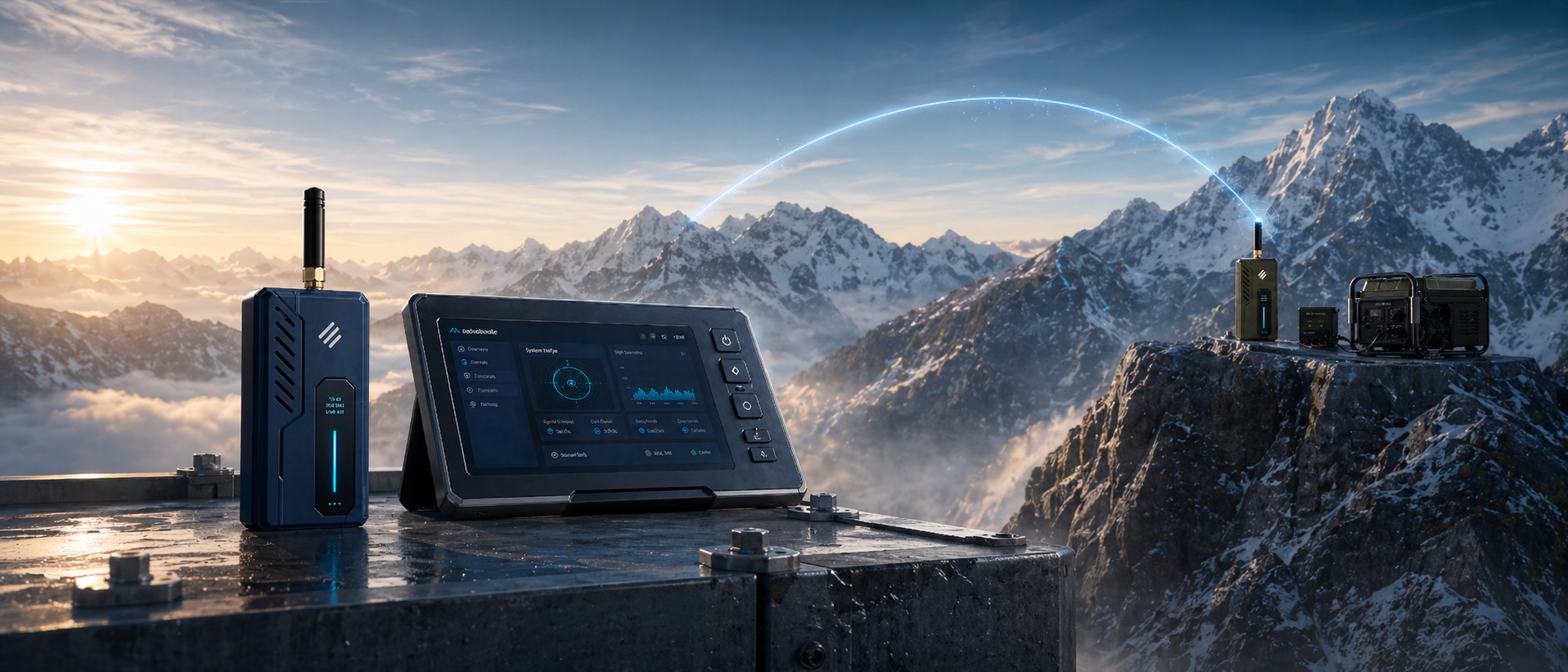
Autoabode's MeshVani platform was built for exactly this terrain. The MeshVani encrypted LoRa communicator and the MeshVani Relay extend coverage across dead zones using frequency-hopping spread spectrum and a self-healing mesh, so a single failed node does not take the network down. Where a cellular sensor simply goes dark outside tower range, a MeshVani node hops its traffic through the nearest relay — making it a natural backbone for rural IoT, disaster-relief and forward-area deployments. Explore the full radio and communications range for the complete platform.
Power Budget: Usually the Deciding Factor
For a deployment that must run for years on a battery, power is not one consideration among many — it is usually the consideration. This is where LoRa's design philosophy pays off most visibly. A LoRa endpoint spends almost all of its life asleep, waking briefly to transmit a small packet and returning to microamp-level sleep. Well-designed LoRa sensors routinely deliver multi-year battery life on a single primary cell because the radio is active for milliseconds per day.
NB-IoT and Cat-M1 have closed much of the historic gap with power-saving modes such as PSM and eDRX, and in a strong-signal environment a cellular IoT sensor can also last for years. The catch is that those power savings depend on a clean link. In a weak-signal rural environment the device burns energy retransmitting, re-attaching to the network and holding its radio active while it negotiates with a distant tower, and real-world battery life can fall dramatically below the datasheet promise. The weaker and more marginal the coverage, the more decisively the power argument favours LoRa.
- LoRa endpoint in good conditions: multi-year life on a primary cell, radio active milliseconds per day
- NB-IoT in strong signal: comparable multi-year life using PSM and eDRX sleep modes
- NB-IoT in marginal rural signal: battery life can collapse to months due to retransmissions and re-attach cycles
- Rule of thumb: the worse the coverage, the more power-efficiency favours LoRa over cellular
Throughput and Latency: Match the Technology to the Payload
If your application genuinely needs to move kilobytes or megabytes — firmware-over-the-air for a complex edge device, periodic image capture, or near-real-time control of fast-moving equipment — LoRa is the wrong tool and LTE Cat-M1 is the right one. There is no point engineering a heroic LoRa architecture around a payload it was never meant to carry. But most rural sensing payloads are tiny and tolerant of latency measured in minutes. A soil-moisture reading that arrives within a five-minute window is just as useful as one that arrives in two seconds, and the network that delivers it for a fraction of the power and recurring cost is the better engineering choice.
The Cost Model That Procurement Actually Cares About
The headline price of a module rarely decides a deployment; the five-year total cost does. LTE IoT carries a recurring per-SIM data cost that, multiplied across hundreds or thousands of nodes and several years, becomes the dominant line item. LoRa carries higher upfront infrastructure cost — you buy and site your own gateways or relays — but essentially zero recurring airtime cost once the network is up, because you own the spectrum use under India's licence-exempt sub-GHz band rules. The crossover is straightforward: small, dense, short-lived deployments inside good coverage often favour cellular; large, sparse, long-lived deployments in poor coverage almost always favour LoRa once the recurring SIM bill is honestly projected over the asset's life.
- LTE/NB-IoT: lower upfront hardware, recurring per-SIM data cost that scales with node count and years
- LoRa: higher upfront gateway/relay cost, near-zero recurring airtime on licence-exempt sub-GHz spectrum
- Crossover favours LoRa as node count, deployment lifetime and coverage difficulty all increase
- Always model total cost of ownership across the full asset life, not the module price
Security: Do Not Treat It as an Afterthought
Rural IoT is increasingly attached to things that matter — irrigation infrastructure, electricity distribution, border sensing — which makes link security a first-class requirement rather than a box to tick. Cellular networks provide carrier-grade authentication and encryption at the network layer, which is a genuine strength of LTE-based IoT. Generic LoRaWAN provides AES-128 at the network and application layers, which is adequate for many commercial uses but leaves key management and join procedures as the responsibility of the integrator, and weak key handling is the most common real-world failure.
This is where the platform you build on matters more than the modulation. Autoabode's MeshVani devices wrap LoRa transport in AES-256-GCM authenticated encryption with frequency-hopping spread spectrum, which both protects payload confidentiality and makes the link far harder to detect, jam or spoof than a fixed-channel LoRaWAN node. For deployments where the data is sensitive or the environment is contested, that hardened security posture often outweighs every other factor in the comparison. For a head-to-head on the firmware and mesh-security differences against the popular open-source option, see our MeshVani vs Meshtastic comparison.
A Practical Decision Framework
Rather than asking the abstract question of whether LoRa or LTE is better, ask four concrete questions about your specific deployment and let the answers point to the architecture. First, what is the real coverage at the device location, measured for a low-power device inside its actual enclosure, not for a phone in the open? Second, how large and how time-sensitive is each payload? Third, how long must the node run on its power source, and is mains power available? Fourth, how sensitive is the data and how contested is the radio environment? A deployment with marginal coverage, tiny payloads, multi-year battery life and sensitive data points unambiguously toward a hardened LoRa mesh. A deployment with good coverage, large payloads, mains power and modest security needs points toward LTE Cat-M1.
- Marginal coverage + tiny payloads + multi-year battery + sensitive data → hardened LoRa mesh (e.g. MeshVani)
- Good coverage + large or time-critical payloads + mains power → LTE Cat-M1
- Mixed coverage across a wide area → LoRa with a relay backbone for uniform reliability
- Always validate coverage at the device, inside its real enclosure, before committing to cellular
The Indian Context in 2026
Two trends make this decision sharper in 2026 than it was even two years ago. First, the push for Atmanirbhar Bharat and Make in India in critical infrastructure means that procurement increasingly values indigenous, auditable communication hardware over imported black-box modules, particularly for anything touching defence, power or water. Second, the maturing of domestic LoRa platforms means that the historic weakness of LoRa — fragmented, integrator-dependent security and patchy mesh reliability — has been substantially addressed by engineered products designed for Indian terrain and threat models. The result is that for a large class of rural Indian IoT deployments, a domestically built, encrypted LoRa mesh is no longer the compromise option; it is the better-engineered one. Where cellular fits, use it without apology. Where coverage, power and security all pull the other way, a platform like MeshVani is built for precisely that gap. To benchmark your own requirement, the Autoabode applications team can model coverage and power for your site — reach us at info@autoabode.com.
Frequently Asked Questions
Q: Is LoRa better than LTE for rural IoT in India? A: It depends on the deployment, but for the common rural profile — marginal coverage, tiny payloads, multi-year battery life and sensitive data — LoRa is usually the better engineering choice. LTE and its NB-IoT and Cat-M1 variants are excellent where coverage is reliable and payloads are large, but in the field interior beyond strong tower coverage, low-power cellular sensors often suffer poor battery life and dropped links. LoRa needs no existing infrastructure because you own both ends of the link, which is why it dominates genuinely remote sites. The honest answer for any site comes from measuring real coverage at the device location and projecting total cost over the asset's life.
Q: How far does LoRa actually reach in rural conditions? A: Marketing figures of fifteen kilometres or more are achievable only under clear line-of-sight with a high, well-sited gateway antenna. A realistic planning figure in flat agricultural terrain is roughly five to twelve kilometres for reliable uplink, depending on antenna quality and spreading factor. In forested or hilly terrain that drops toward one to two kilometres per hop, which is why a mesh or relay architecture such as the MeshVani Relay matters more than raw point-to-point range for difficult terrain.
Q: Will an NB-IoT sensor's battery really last as long as the datasheet says? A: Only in strong signal. NB-IoT and Cat-M1 use power-saving modes like PSM and eDRX that can deliver multi-year life when the link is clean. In marginal rural coverage the device burns energy retransmitting and re-attaching to a distant tower, and real-world battery life can fall from years to months. The weaker the coverage, the more decisively power efficiency favours a well-designed LoRa endpoint, which spends almost its entire life asleep.
Q: Is LoRa secure enough for critical infrastructure? A: Generic LoRaWAN provides AES-128 encryption, which is adequate for many commercial uses but leaves key management to the integrator, and weak key handling is the most common failure. For critical or contested deployments, choose a hardened platform: Autoabode's MeshVani wraps LoRa in AES-256-GCM authenticated encryption with frequency-hopping spread spectrum, which protects the payload and makes the link far harder to detect, jam or spoof than a fixed-channel node. The platform you build on matters more for security than the modulation itself.
Q: How do the costs of LoRa and LTE IoT compare over time? A: LTE IoT has lower upfront hardware cost but a recurring per-SIM data charge that, across many nodes and several years, usually becomes the dominant cost. LoRa has higher upfront infrastructure cost because you buy and site your own gateways or relays, but near-zero recurring airtime cost on India's licence-exempt sub-GHz spectrum. The crossover favours LoRa as node count, deployment lifetime and coverage difficulty increase, so always model total cost of ownership over the full asset life rather than comparing module prices.
Priya Mehta
Applications Engineer, Autoabode · Autoabode Consumer Electronics Pvt. Ltd.
Expert author at Autoabode — writing at the intersection of industrial 3D printing, defence manufacturing, and advanced UAV systems. Based in New Delhi, India.
Explore Autoabode's Platforms
This article is part of Autoabode's technical journal. Learn more about our core platforms built in India for defence, aerospace, medical and industrial teams:
More from the Journal
Off-Grid Communication Solutions for Mountainous Terrain: An Engineering Field Guide for India's High-Altitude Operators
Off-grid communication solutions for mountainous terrain are not optional in India — they are the difference between a coordinated operation and a stranded section. This engineering field guide breaks down the radio physics that defeats conventional VHF/UHF in the Himalayas, the mesh architectures that survive ridge-line shadowing, and the cold-weather, power-budget and security trade-offs that determine whether a system delivers in the Karakoram and Western Ghats. Built around real deployment data from Autoabode's MeshVani encrypted communicator and MeshVani Relay platform in service with the Indian Army, ITBP, NDRF and high-altitude expedition teams.
Drones & UAV · 7 min readModular UAV Payloads for Multi-Role Missions: A Technical Guide
Explore the technical specifications and strategic advantages of modular UAV payloads for multi-role missions. This guide covers hot-swap systems, sensor fusion, and real-world applications for defense and industry.