
3D Concrete Printing for Affordable Housing in India: Costs, Speed, and What It Really Takes to Build a Home Faster
Priya Mehta
Applications Engineer, Autoabode · Autoabode
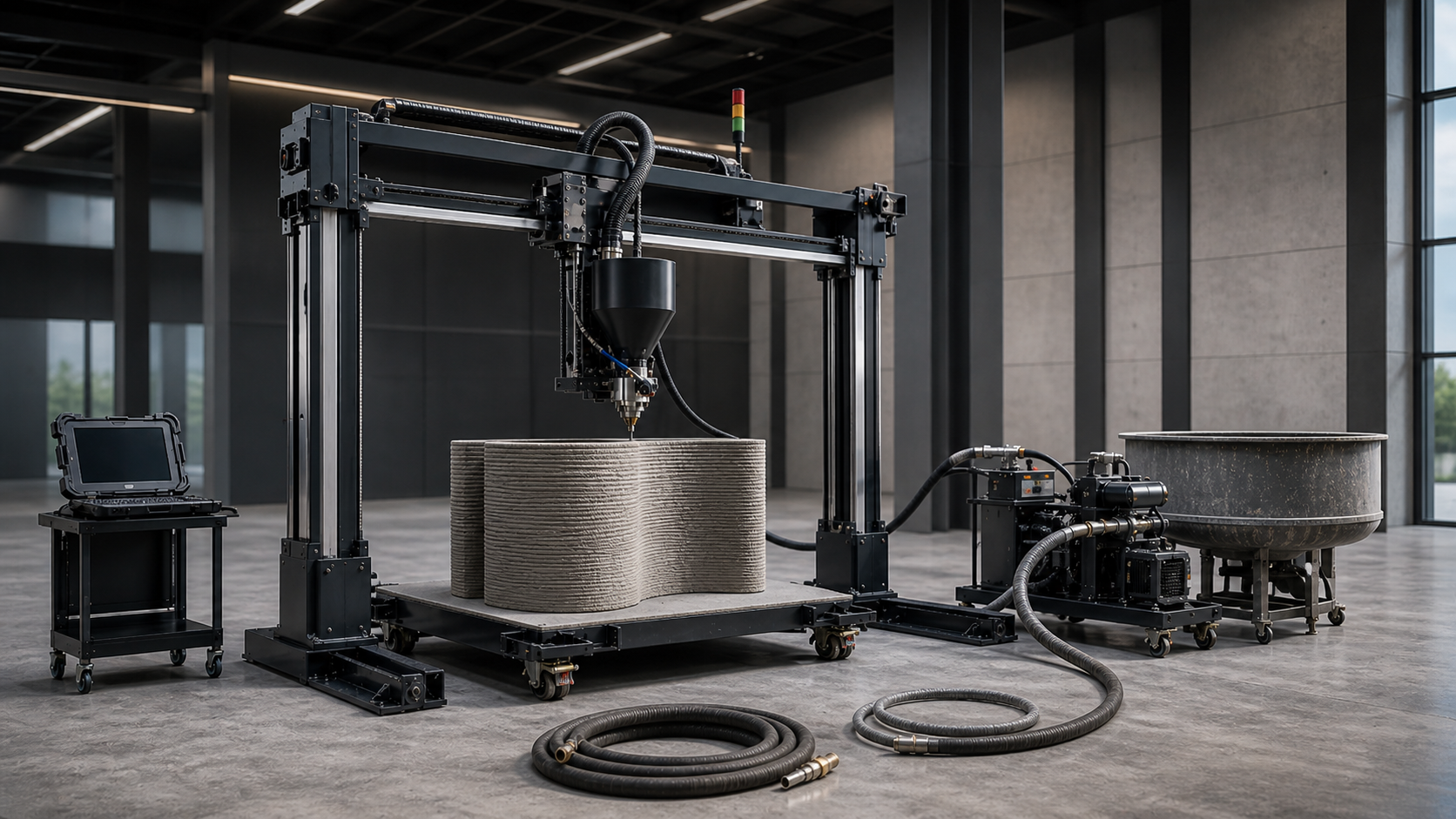
India needs to build homes at a pace and price point that conventional construction has never sustainably achieved. Under the Pradhan Mantri Awas Yojana and successive state housing missions, the country has committed to tens of millions of dwelling units, and the gap between the target and the delivery rate remains the single hardest problem in Indian housing. 3D concrete printing is increasingly cited as part of the answer — a 3D printed house in Tamil Nadu has already been completed in under a week, and pilot printed structures now exist in several states. But between a press-release pilot and a financed, repeatable affordable-housing programme lies a large amount of engineering and economics that rarely gets discussed. This article looks honestly at where additive construction genuinely lowers the cost and time of building a home in India, where it does not yet, and what a buyer or housing developer should understand before committing.
Where the Cost Actually Comes From in a Built Home
To understand whether printing saves money, you have to separate the cost of a finished house into its real components. For a typical low-cost single-storey unit in India, the superstructure walls — the part a printer replaces — account for only a portion of total cost. Foundation work, roofing, doors and windows, electrical and plumbing, flooring, finishing, and labour overheads make up the majority. This matters because the headline claim that 3D printing 'cuts construction cost by 30 percent' refers almost entirely to the walling and shuttering portion, not the whole building. A realistic expectation is that printing reduces the masonry-and-formwork share of the budget meaningfully — chiefly by eliminating brick or block laying labour, removing the need for wall formwork, and compressing the schedule — while leaving the rest of the build roughly unchanged.
The two genuine savings are labour and time. A gantry printer extrudes wall geometry continuously, replacing a skilled-mason-intensive activity with a small supervised crew. And because printed walls go up in hours rather than days, the carrying cost of the project — site overheads, financing, supervision — falls proportionally with the schedule. In a country where construction labour availability is increasingly unpredictable, removing the dependency on large masonry crews is itself a structural advantage, even before the rupee savings are counted.
Speed: The Most Defensible Advantage
The most reliably demonstrated benefit of additive construction is build speed. The structural walls of a single-storey home of around 600 to 1,000 square feet can be printed in roughly two to five days of machine time, depending on wall height, geometry, and the number of openings. That is the part of the schedule that printing compresses most dramatically — a wall package that traditionally takes two to three weeks of bricklaying and curing collapses into a few days of continuous extrusion. For a housing programme delivering hundreds or thousands of identical units, that schedule compression compounds: a single gantry system can cycle through far more foundations-to-roof handoffs per year than a conventional crew of the same headcount.
Speed also unlocks design repeatability. Once a unit design is sliced and validated, every subsequent print is identical, eliminating the dimensional variance that creeps into hand-laid masonry. For affordable housing, where standardised layouts are the norm, this consistency reduces downstream rework in fitting doors, windows, and prefabricated roofing.
AutoAbode's Gantry 3D Concrete Printer prints structural walls across a 2000 x 2000 x 2500 mm build envelope with rack-and-pinion servo drive and +/-0.5 mm precision — sized for room-scale and modular dwelling segments that can be printed on-site or in a controlled yard and assembled. Explore the platform on the Gantry 3D Concrete Printer page.
The Material Question: What You Actually Print With
Printable concrete is not ordinary ready-mix. It must be pumpable and extrudable while flowing, then stiffen fast enough to hold its own weight and support the layers above without slumping — a property called buildability. Achieving this balance requires a carefully designed mix with controlled aggregate size, supplementary cementitious materials, and admixtures that tune the open time and early strength. The dependence on high cement content is also the technology's biggest sustainability and cost question, because cement is both expensive and carbon-intensive.
This is precisely where Indian research is most active. Geopolymer and fly-ash-based mixes, which substitute industrial by-products for a large fraction of Portland cement, are being developed specifically to lower both the rupee cost and the carbon footprint of printed walls while improving buildability. Any serious affordable-housing deployment should treat the printer and the mix as a single system — a machine that can only run one proprietary, imported mix is a long-term cost trap. An open-material platform that lets a builder or research group develop and qualify locally sourced mixes is far better aligned with the economics of Indian housing. We cover the material science in depth in our complete guide to gantry-based 3D concrete printing.
Structural and Regulatory Reality
A printed wall is layered, and layering creates two engineering concerns: bond strength between layers and reinforcement. Inter-layer adhesion depends on printing the next layer within the open time of the previous one, which is why mix design and print scheduling are inseparable. Reinforcement is the harder problem — conventional reinforced concrete relies on continuous steel, but a printer cannot easily lay horizontal rebar inside an extruded wall. Practical approaches include printing hollow wall geometries that are later filled with reinforced concrete, placing vertical bars through printed cavities, and using fibre-reinforced mixes for non-structural or low-load elements. For multi-storey or seismic-zone construction, these details must be designed and certified, not improvised.
Regulation is catching up rather than blocking. The Bureau of Indian Standards and national research bodies have been working toward guidelines for 3D printed construction, and completed printed buildings have already passed structural validation in India. For a developer, the prudent path is to engage a structural consultant early and treat printed affordable housing as an engineered system that complies with the National Building Code, not as a way to bypass it.
Does the Math Work for a Housing Developer?
The honest answer is: it depends on volume. A gantry concrete printer is a capital asset. Spread across a handful of demonstration homes, the per-unit cost of the machine swamps any labour savings, and conventional masonry wins. Spread across hundreds of standardised units — the scale at which PMAY-type programmes actually operate — the machine's capital cost amortises to a small fraction of each home, the labour and schedule savings dominate, and the economics turn clearly favourable. Additive construction is a volume technology. It rewards housing missions, large developers, and institutional builders, and it punishes one-off vanity projects.
There is also a workforce and localisation argument that matters in the Indian context. A domestically manufactured, open-material gantry printer keeps spare parts, service, mix development, and operator training inside the country, avoiding the foreign-exchange exposure and multi-week service delays that come with imported European systems costing several crore. For a programme meant to deliver affordable homes for a decade, serviceability and local support are not luxuries — they are the difference between a productive asset and an expensive paperweight.
A Realistic Path to Printed Affordable Housing
The sensible adoption path is incremental. Start with a single validated unit design, qualify a locally sourced mix on the actual machine, complete a small batch of homes with full structural certification, and only then scale to a production cadence. Pair the printer with prefabricated roofing, standardised door and window modules, and a fixed electrical-plumbing layout so that the entire build — not just the walls — is industrialised. The walls are where printing shines; the savings are realised only when the rest of the process is engineered to match that pace. Builders and research institutions evaluating a system for housing work can talk to our team about machine specifications, mix qualification, and pilot project planning.
Frequently Asked Questions
Q: How much does it cost to 3D print a house in India? A: There is no single figure, because printing only replaces the walling-and-formwork portion of a home, not the foundation, roof, finishes, or services. On that walling portion, printing can reduce cost meaningfully by removing masonry labour and wall formwork. Across a full home the saving is more modest, and it only becomes financially compelling at volume, when the printer's capital cost amortises across many units. For a one-off home, conventional construction usually remains cheaper.
Q: How fast can a 3D printer build a house? A: The structural walls of a single-storey home of roughly 600 to 1,000 square feet can be printed in about two to five days of machine time. That is only the wall package — foundation, roofing, finishing, and services still follow on a normal schedule. The dramatic speed claims you see in the press refer specifically to this printed-wall stage, which is genuinely the fastest part of the build.
Q: Is a 3D printed house structurally safe and legal in India? A: Yes, when engineered and certified properly. Completed printed buildings in India have passed structural validation, and national standards bodies are actively developing guidelines. The key requirement is reinforcement strategy — typically printing hollow walls that are later filled with reinforced concrete — and certification by a structural consultant in line with the National Building Code, especially in seismic zones or for multi-storey work.
Q: What concrete is used in 3D printing, and can it use Indian materials? A: Printed concrete is a specially designed mix that is pumpable while flowing and stiffens quickly to support successive layers. Indian research is strongly focused on geopolymer and fly-ash-based mixes that replace much of the Portland cement with industrial by-products, lowering both cost and carbon. The most flexible choice is an open-material printer that lets you qualify locally sourced mixes rather than locking you into one imported proprietary blend.
Q: Is 3D concrete printing worth it for affordable housing programmes? A: For large, standardised programmes such as PMAY-scale delivery, yes — the schedule compression, reduced dependence on scarce masonry labour, and unit repeatability compound powerfully across hundreds or thousands of homes, and the machine cost amortises to a small per-unit figure. For small or one-off projects the economics rarely work. Additive construction is fundamentally a volume technology, best paired with industrialised roofing, fittings, and services so the whole build keeps pace with the printed walls.
Priya Mehta
Applications Engineer, Autoabode · Autoabode Consumer Electronics Pvt. Ltd.
Expert author at Autoabode — writing at the intersection of industrial 3D printing, defence manufacturing, and advanced UAV systems. Based in New Delhi, India.
Explore Autoabode's Platforms
This article is part of Autoabode's technical journal. Learn more about our core platforms built in India for defence, aerospace, medical and industrial teams:
More from the Journal
Off-Grid Communication Solutions for Mountainous Terrain: An Engineering Field Guide for India's High-Altitude Operators
Off-grid communication solutions for mountainous terrain are not optional in India — they are the difference between a coordinated operation and a stranded section. This engineering field guide breaks down the radio physics that defeats conventional VHF/UHF in the Himalayas, the mesh architectures that survive ridge-line shadowing, and the cold-weather, power-budget and security trade-offs that determine whether a system delivers in the Karakoram and Western Ghats. Built around real deployment data from Autoabode's MeshVani encrypted communicator and MeshVani Relay platform in service with the Indian Army, ITBP, NDRF and high-altitude expedition teams.
Drones & UAV · 7 min readModular UAV Payloads for Multi-Role Missions: A Technical Guide
Explore the technical specifications and strategic advantages of modular UAV payloads for multi-role missions. This guide covers hot-swap systems, sensor fusion, and real-world applications for defense and industry.