
LoRa Frequency Bands in India: WPC Rules, ERP Limits and ETA Compliance for 865-867 MHz
Priya Mehta
Applications Engineer, Autoabode · Autoabode
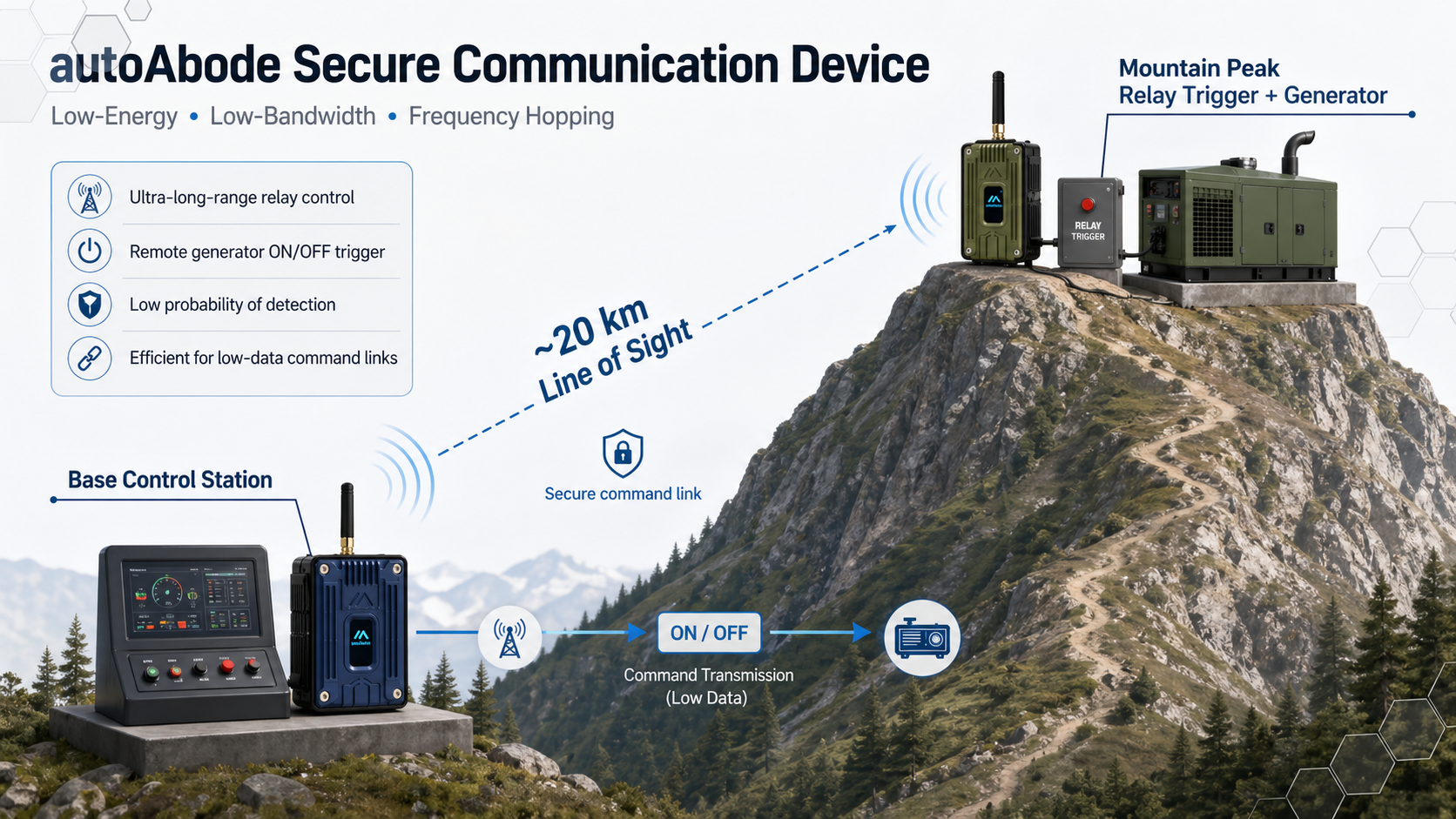
There is a specific conversation we have several times a month. An engineering team has built something good: a soil-moisture network across four hundred hectares, a tunnelling crew's underground telemetry link, a forest-department tracker, a campus LoRaWAN pilot. It works. Then someone asks what frequency it is on, and the answer is 868.1 MHz, because that was the default in the firmware that shipped with the module. At that moment the deployment is outside the Indian licence exemption, and has been since the first node was switched on.
This is not an exotic failure. The global LoRa ecosystem is built around European and North American band plans, and the path of least resistance in almost every SDK, every Arduino example and every gateway default configuration leads to EU868 or US915. Neither is legal in India. The Indian exemption is narrower than the European one, the power limits are expressed in a unit that most datasheets do not use, and the constraint that actually determines whether your network scales is not transmit power at all. This guide covers what the rules say, what they mean in engineering terms, and how to specify hardware that will survive a compliance question.
The Legal Baseline: What G.S.R. 853(E) Actually Says
The governing instrument is the Use of Low Power Equipment in the Frequency Band 865-868 MHz for Short Range Devices (Exemption from Licence) Rules, 2021, notified as G.S.R. 853(E) on 10 December 2021. It was issued under the Indian Telegraph Act, 1885 and the Indian Wireless Telegraphy Act, 1933, and it supersedes the older 2005 RFID rules that restricted the band to 865-867 MHz. Equipment already type-approved under the 2005 rules remains valid for the rest of its service life, which is why you will still see 865-867 MHz quoted as the Indian band in older documentation and in the LoRa Alliance regional plan name.
Rule 3 is the operative clause. No licence is required to establish, maintain, work, possess or deal in short range wireless equipment in this band, provided you comply with the technical specifications in four tables and accept that your operation is on a non-interference, non-protection, shared and non-exclusive basis. Those last four words are not boilerplate, and we come back to them below.
The four tables divide the band by application class, and each class gets a different power and channel-access budget:
- Table I - Non-Specific Short Range Devices (telemetry, telecommand, alarms, general data): 25 mW e.r.p., 1 percent duty cycle, FHSS permitted with maximum occupied bandwidth of 50 kHz across 58 or more hop channels. Referenced standard EN 300 220.
- Table II - Tracking, Tracing and Data Acquisition Devices (metering, environmental sensors, actuators, wireless industrial applications, worker monitoring): 500 mW e.r.p., Adaptive Power Control mandatory, duty cycle 10 percent for network access points and 2.5 percent otherwise, channel bandwidth 200 kHz or less.
- Table III - Wideband Data Transmission Systems: 25 mW e.r.p., duty cycle 10 percent for network access points and 2.8 percent otherwise, occupied bandwidth above 600 kHz and up to 1 MHz.
- Table IV - RFID: 2 W e.r.p., 200 kHz channels, maximum 4 seconds of continuous interrogator transmission and at least 100 ms between consecutive transmissions on the same channel. The 2 W allowance applies only to the four channels centred at 865.7, 866.3, 866.9 and 867.5 MHz.
Most LoRa and LPWAN work lands in Table I or Table II. Which one you are in is determined by what the equipment does, not by what you would prefer. A gateway aggregating utility meter data is comfortably a Table II network access point. A generic point-to-point telemetry link carrying arbitrary payloads is Table I, with a twenty-fold lower power ceiling and a tighter duty cycle. Getting this classification wrong is the second most common compliance error after the band itself.
e.r.p. Is Not EIRP: The 2.15 dB Nobody Accounts For
Rule 2 defines effective radiated power explicitly as the product of the power supplied to an antenna and its gain relative to a half-wave dipole. EIRP, the figure almost every radio module datasheet and every LoRaWAN regional parameter document quotes, is referenced to an isotropic radiator instead. A half-wave dipole has 2.15 dBi of gain over isotropic, so the two numbers differ by a fixed offset: EIRP in dBm equals e.r.p. in dBm plus 2.15.
Run the arithmetic on the two limits that matter. The Table I ceiling of 25 mW e.r.p. is 14 dBm e.r.p., which corresponds to 16.15 dBm EIRP, or about 41 mW EIRP. The Table II ceiling of 500 mW e.r.p. is 27 dBm e.r.p., which is 29.15 dBm EIRP, or roughly 822 mW EIRP. An engineer who reads 500 mW in the rules, sets a 27 dBm conducted output on the module and then bolts on a 6 dBi collinear antenna is radiating 33 dBm EIRP, which is around 31 dBm e.r.p. That is four times the legal limit, and it happened purely through an antenna choice that felt like good engineering practice.
The practical rule for a compliant link budget: conducted power at the connector, plus antenna gain in dBi, minus feeder and connector loss, minus 2.15, must stay at or below 14 dBm for Table I equipment and 27 dBm for Table II. High-gain antennas are not free range in India. They are borrowed from your power budget.
Duty Cycle Is the Real Constraint
Power gets the attention because it is the number on the box. Duty cycle is what actually determines whether your network scales, and in our experience it is the limit that bites first and hardest. A 1 percent duty cycle means each transmitter may occupy the air for 36 seconds in any one-hour observation window. At 2.5 percent you get 90 seconds. A Table II network access point at 10 percent gets six minutes an hour.
Now put LoRa airtime against that budget. A 50-byte payload at spreading factor 12 on a 125 kHz channel takes somewhere in the region of 2.5 to 3 seconds of airtime. That means a single Table I node running at SF12 can send roughly a dozen messages an hour before it exhausts its allowance. The same payload at SF7 takes around 100 milliseconds, which allows several hundred transmissions an hour but costs you roughly 10 dB of link budget.
What This Forces You to Design For
- Budget airtime, not messages. Specify your network in seconds-per-hour per node and compute backwards to a reporting interval, rather than picking a reporting interval and hoping.
- Adaptive data rate is a compliance feature, not just an optimisation. Nodes close to a gateway should drop to lower spreading factors so they stop consuming airtime they do not need.
- Acknowledgements and downlinks consume the gateway's budget, and the gateway is shared across every node. A network that acknowledges every uplink will hit the access point ceiling long before the end devices hit theirs.
- Firmware retry logic is where duty cycle compliance quietly dies. An exponential backoff that retries aggressively during a link outage can burn an hour's allowance in ninety seconds.
- For Table II equipment, Adaptive Power Control is mandatory, not optional. The rule requires it, so the radio stack must be able to reduce transmit power when link margin allows.
One detail in Table I is easy to miss and important for hopping systems: the duty cycle applies to the entire transmission, not to each hop channel individually. You cannot reclaim airtime by spreading it across 58 channels. The cumulative on-air time is what counts.
The 868 MHz Trap: Why EU Modules Are Not Drop-In Legal
The European EU868 plan and the Indian allocation overlap, which is exactly what makes the mistake so easy. The Indian exemption tops out at 868 MHz. The three workhorse EU868 LoRaWAN channels sit at 868.1, 868.3 and 868.5 MHz, all of them above that ceiling. A module flashed with the EU868 regional plan will join, transmit cleanly, and show excellent link statistics, while operating outside the exemption on its primary channels.
The correct plan is IN865-867, defined in the LoRa Alliance regional parameters for India. Its three mandatory default channels are 865.0625 MHz, 865.4025 MHz and 865.985 MHz, and additional channels may be provisioned within the permitted band. Set this explicitly in device firmware and in the gateway configuration, and verify it on a spectrum analyser rather than trusting the configuration file.
There is a second-order trap here too. Regional parameter documents carry their own default maximum EIRP values, and those defaults are not the Indian legal limit. The LoRa Alliance plan describes what the protocol permits; G.S.R. 853(E) describes what the law permits. Where they disagree, the notification wins. Configure your network server's maximum EIRP setting down to the figure derived from the applicable table, and treat any regional-parameter default above it as a value to be overridden rather than inherited.
Where Frequency Hopping Fits
Table I permits frequency hopping spread spectrum explicitly, and this is worth dwelling on because it is often assumed that hopping requires a licence in India. It does not, within the stated conditions: maximum occupied bandwidth of 50 kHz, 58 or more hop channels, and the 1 percent duty cycle applied cumulatively. For anyone building tactical, industrial or disaster-response links, this is the most operationally useful line in the entire notification.
Hopping buys two things that a fixed-channel link cannot. The first is interference resilience. In the 865-868 MHz band you are sharing spectrum with RFID interrogators radiating up to 2 W e.r.p., with metering networks, and with whatever else a neighbouring site has deployed. A fixed-channel link that lands on an active RFID channel simply stops working. A hopping link loses the packets that collide and carries on. The second is a meaningful increase in the difficulty of casual interception and of narrowband jamming, because an adversary must either follow the hop sequence or fill the whole band.
MeshVani is Autoabode's AES-256-GCM encrypted LoRa mesh communicator, designed and manufactured in New Delhi around the Indian band plan rather than retrofitted from a European reference design. For longer spans, the MeshVani Relay adds an FHSS encrypted relay node reaching up to 20 km between hops, letting you build coverage across terrain where a single link would never close. Both sit inside the de-licensed 865-868 MHz allocation, so there is no spectrum licence to obtain before deployment. You can see the wider product family on the radio systems page.
Other De-Licensed Bands Worth Knowing
865-868 MHz is not the only licence-exempt option, and picking the right band at the specification stage saves a great deal of trouble later:
- 433-434.79 MHz, covered by its own notification: very low power, commonly cited at 10 mW e.r.p. with narrow channel bandwidth. Adequate for remote controls and simple telecommand; far too tight for anything resembling a data network.
- 2.4-2.4835 GHz, de-licensed under G.S.R. 45(E): the Wi-Fi and Bluetooth band. Plenty of bandwidth, poor propagation through vegetation and terrain, and heavily congested in any populated area.
- 5.150-5.350 GHz and 5.725-5.875 GHz, de-licensed under G.S.R. 46(E) and related notifications, with indoor and power restrictions that vary by sub-band. Suitable for point-to-point backhaul where line of sight exists.
- G.S.R. 1047(E), the omnibus short range device notification, which covers a broad set of bands from 169 MHz up to 61 GHz for specific device categories.
For long-range, low-data-rate work over Indian terrain, the sub-GHz band remains the only sensible choice. Propagation at 866 MHz through foliage, over ridgelines and around buildings is in a different class to 2.4 GHz, and the difference is measured in kilometres rather than percentages.
Equipment Type Approval: What ETA Actually Requires
De-licensed does not mean unregulated. Rule 5 requires that equipment operating under the exemption be type approved, that it comply with the referenced harmonised standard, and that safety requirements follow ITU, ETSI, ANSI, BIS or ICNIRP norms as applicable. For devices operating wholly within de-licensed bands, this is handled as Equipment Type Approval on a self-declaration basis through the Department of Telecommunications Saral Sanchar portal.
The practical sequence looks like this:
- Get an RF test report for the exact model from an accredited laboratory, covering occupied bandwidth, radiated power, spurious and harmonic emissions, and frequency stability against the referenced EN standard.
- Register on the Saral Sanchar portal and file the ETA application against a specific model number. A separate application is required for each equipment type.
- Pay the prescribed government fee, listed at Rs 10,000 per model at the time of writing. Confirm the current figure on the portal before you budget.
- For genuinely de-licensed-band equipment the certificate is typically issued without further technical scrutiny once the test evidence is on file, and can be downloaded from the portal.
- Retain the ETA reference. It is what an importer, a customs officer, a procurement committee or an institutional compliance team will ask for.
If you are buying rather than building, make this concrete: ask any vendor for the ETA reference tied to the exact model number on the purchase order, not to a product family or a predecessor model. Ask us the same question. A supplier who cannot produce it for the specific variant you are buying has handed you a problem that will surface at the worst possible time, usually during import clearance or an institutional audit.
Non-Interference, Non-Protection: What It Means on a Bad Day
Rule 4 deserves more attention than it usually gets. Operating under the exemption means two asymmetric things. You have no protection: if a licensed service or another exempt user degrades your link, you have no remedy and cannot demand a clear channel. And you carry an obligation: if a licensed operator reports harmful interference from your equipment, the authority can require you to relocate it, reduce power or fit a different antenna, and can ultimately recommend that you stop using it. The rules do provide that you get a reasonable opportunity to be heard before any such recommendation.
For a hobby project this is abstract. For anything carrying operational traffic it is a design input. It argues for mesh topologies over single-path links, for hopping over fixed channels, for planning a fallback bearer on any network whose failure has consequences, and for keeping an as-built record of node locations, antenna types and configured power so that an interference complaint can be answered with data rather than guesswork.
A Compliance Checklist Before You Deploy
- Confirm the regional plan is IN865-867 in both device firmware and gateway configuration, and verify on a spectrum analyser. No channel above 868 MHz.
- Classify your equipment against Table I, II, III or IV and write down which one, and why. This determines your power and duty-cycle ceiling.
- Compute radiated power as e.r.p., not EIRP. Subtract 2.15 dB from any EIRP figure before comparing it to the limit.
- Include antenna gain and subtract feeder loss in that calculation. Changing an antenna changes your compliance position.
- Model worst-case airtime per node per hour, including retries and downlinks, and confirm it fits the duty cycle for your table.
- Enable Adaptive Power Control if you are operating under Table II. It is a requirement, not a nice-to-have.
- Obtain or verify the ETA reference for each exact model number in the deployment.
- Record node positions, antenna models, cable lengths and configured power in an as-built document you can produce on request.
- Plan for degradation. Assume at some point another user will appear on your channel, and design the topology so that this is an inconvenience rather than an outage.
None of this is difficult. It is simply not the default, because the tooling and the tutorials were written for other jurisdictions. Teams that handle it at the specification stage spend a few hours on it. Teams that discover it after deploying several hundred nodes spend considerably longer, and sometimes discover that the hardware they standardised on cannot be band-locked to the Indian plan at all. If you are scoping a network and want a second pair of eyes on the band plan and link budget before committing to hardware, get in touch or book a technical session.
Frequently Asked Questions
Q: Do I need a licence to operate LoRa in India?
A: No spectrum licence is required for equipment operating within the 865-868 MHz band and complying with the technical conditions in G.S.R. 853(E). You do, however, need Equipment Type Approval for the equipment itself, obtained on a self-declaration basis through the Saral Sanchar portal, and your operation is on a non-interference, non-protection basis with no right to a clear channel.
Q: Can I use an 868 MHz LoRa module bought from Europe or China in India?
A: Only if the hardware can be retuned to the Indian band and the firmware reconfigured to the IN865-867 regional plan. The standard EU868 default channels at 868.1, 868.3 and 868.5 MHz are above the 868 MHz upper edge of the Indian exemption. Many modules cover the whole 863-870 MHz range in hardware and are perfectly usable once correctly configured, but the module also needs ETA coverage for the model you are importing. Physically capable is not the same as legally cleared.
Q: What is the maximum transmit power for LoRa in India?
A: It depends on which table your equipment falls under. Non-specific short range devices are limited to 25 mW e.r.p., tracking and data acquisition devices to 500 mW e.r.p. with mandatory Adaptive Power Control, wideband data transmission systems to 25 mW e.r.p., and RFID interrogators to 2 W e.r.p. on four designated channels. Remember that these are e.r.p. figures referenced to a half-wave dipole, so subtract 2.15 dB from any EIRP number before comparing.
Q: Is frequency hopping legal on the Indian licence-exempt band?
A: Yes. Table I of the 2021 rules explicitly permits FHSS for non-specific short range devices, subject to a maximum occupied bandwidth of 50 kHz across 58 or more hop channels, 25 mW e.r.p., and a 1 percent duty cycle that applies to the cumulative transmission rather than to each hop channel separately. This is what allows hopping relay systems such as the MeshVani Relay to operate without a spectrum licence.
Q: How long does WPC ETA certification take and what does it cost?
A: For equipment operating entirely within de-licensed bands, ETA is issued on self-declaration and is usually a matter of days once you have an accredited RF test report in hand. The government fee has been listed at Rs 10,000 per model application, though you should confirm the current figure on the portal. The long pole is almost always the laboratory test report, not the portal submission, so start the testing early and apply per model number rather than per product family.
Frequently Asked Questions
No spectrum licence is required for equipment operating within the 865-868 MHz band and complying with the technical conditions in G.S.R. 853(E). You do, however, need Equipment Type Approval for the equipment itself, obtained on a self-declaration basis through the Saral Sanchar portal, and your operation is on a non-interference, non-protection basis with no right to a clear channel.
Priya Mehta
Applications Engineer, Autoabode · Autoabode Consumer Electronics Pvt. Ltd.
Expert author at Autoabode — writing at the intersection of industrial 3D printing, defence manufacturing, and advanced UAV systems. Based in New Delhi, India.
Explore Autoabode's Platforms
This article is part of Autoabode's technical journal. Learn more about our core platforms built in India for defence, aerospace, medical and industrial teams:
More from the Journal
Off-Grid Communication Solutions for Mountainous Terrain: An Engineering Field Guide for India's High-Altitude Operators
Off-grid communication solutions for mountainous terrain are not optional in India — they are the difference between a coordinated operation and a stranded section. This engineering field guide breaks down the radio physics that defeats conventional VHF/UHF in the Himalayas, the mesh architectures that survive ridge-line shadowing, and the cold-weather, power-budget and security trade-offs that determine whether a system delivers in the Karakoram and Western Ghats. Built around real deployment data from Autoabode's MeshVani encrypted communicator and MeshVani Relay platform in service with the Indian Army, ITBP, NDRF and high-altitude expedition teams.
Drones & UAV · 7 min readModular UAV Payloads for Multi-Role Missions: A Technical Guide
Explore the technical specifications and strategic advantages of modular UAV payloads for multi-role missions. This guide covers hot-swap systems, sensor fusion, and real-world applications for defense and industry.